The MOVE FrameworkThe 4-Question Go-to-Market Model for Scaling Companies
A four-question executive framework for understanding where your company is, what needs to change, and how GTM must evolve as your business scales.
 Framework Library
What Go-to-Market Actually Is (And What It Isn’t)
In the Wall Street Journal bestseller MOVE, Sangram Vajre and Bryan Brown introduced a formal definition of Go-to-Market designed to break companies out of departmental silos:
“GTM is a transformational process for accelerating your path to market with high-performing revenue teams delivering a connected customer experience.”
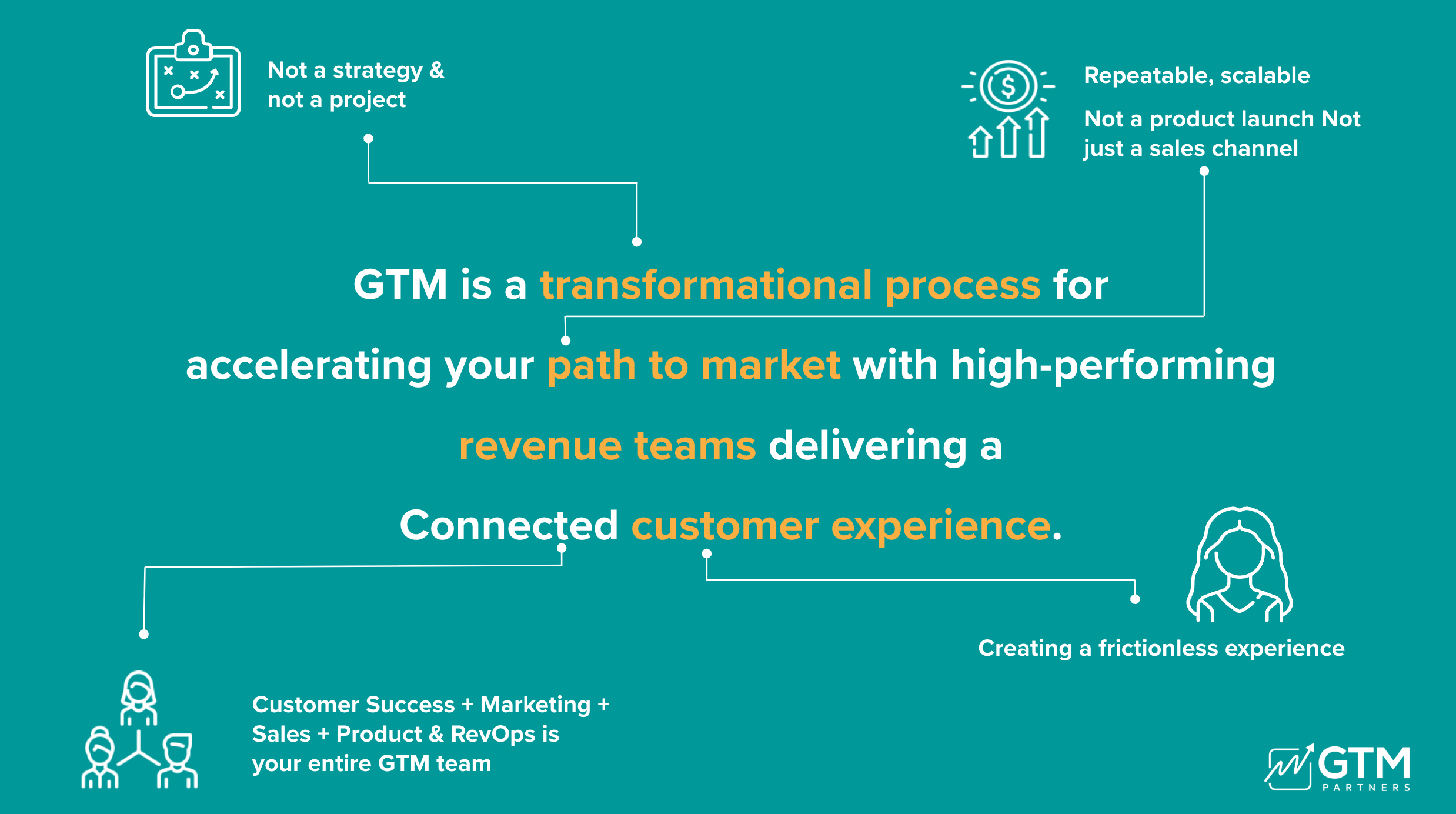
This definition establishes four essential truths every executive team must embrace:
1. A Transformational Process
GTM is not a one-time project, campaign, or product launch. It is an ongoing operating discipline that continuously evolves.
2. Path to Market
A repeatable, scalable revenue pipeline operating at the highest possible ROI — not merely a single sales channel.
3. Revenue Teams
Customer Success + Marketing + Sales + Product working as one unified revenue engine, orchestrated through RevOps.
4. Connected Customer Experience
The buyer is recognized seamlessly at every touchpoint, eliminating painful departmental handoffs and friction.
The 4 Questions Every GTM Leader Must Answer
No matter what stage your company is in, sustainable scale requires clear, executive-level consensus on four fundamental questions. As the business grows, the answers to these questions will change, but the questions themselves remain constant.
Market
Whom should we market to?
Defining the specific segment, industry, and buyer persona where your product creates the highest demonstrable ROI and shortest sales cycle.
Executive Takeaway: Focus on where you win with the highest win rates and lowest CAC, rather than pursuing broad, undifferentiated demand.
Operations
What do we need to operate effectively?
Establishing one unified source of analytical truth and operational handoffs across Marketing, Sales, Customer Success, and Product.
Executive Takeaway: Eliminates departmental dashboard disputes by consolidating reporting under an Executive GTM Scorecard.
Velocity
When can we scale our business?
Measuring and accelerating how quickly new hires reach quota and how consistently revenue teams execute unified plays.
Executive Takeaway: Scaling too early without velocity creates high headcount drag; velocity proves your unit economics are ready for capital.
Expansion
Where can we grow the most?
Determining the optimal expansion vector: selling more to existing accounts (Sales), entering new geos/segments (Coverage), or launching adjacent products (Solutions).
Executive Takeaway: Protects Net Revenue Retention (NRR > 110%) by turning existing customers into the primary growth engine of the enterprise.
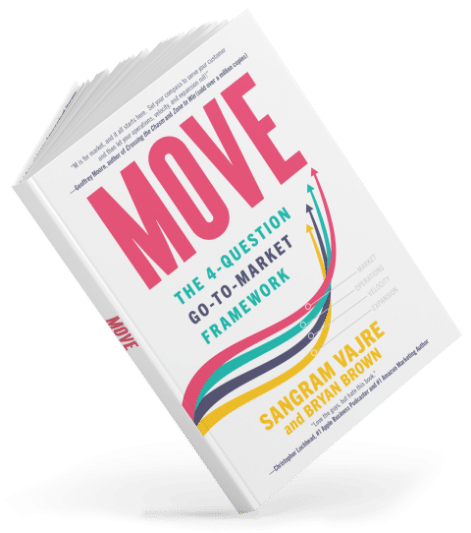
This page is the summary. The book is the full argument.
MOVE explains why your company strategy is not your GTM strategy, lays out the six truths about go-to-market and the 3Ps maturity curve, and shows how the answer to each MOVE question changes as you scale. Chapters 1–4 are free to read online.
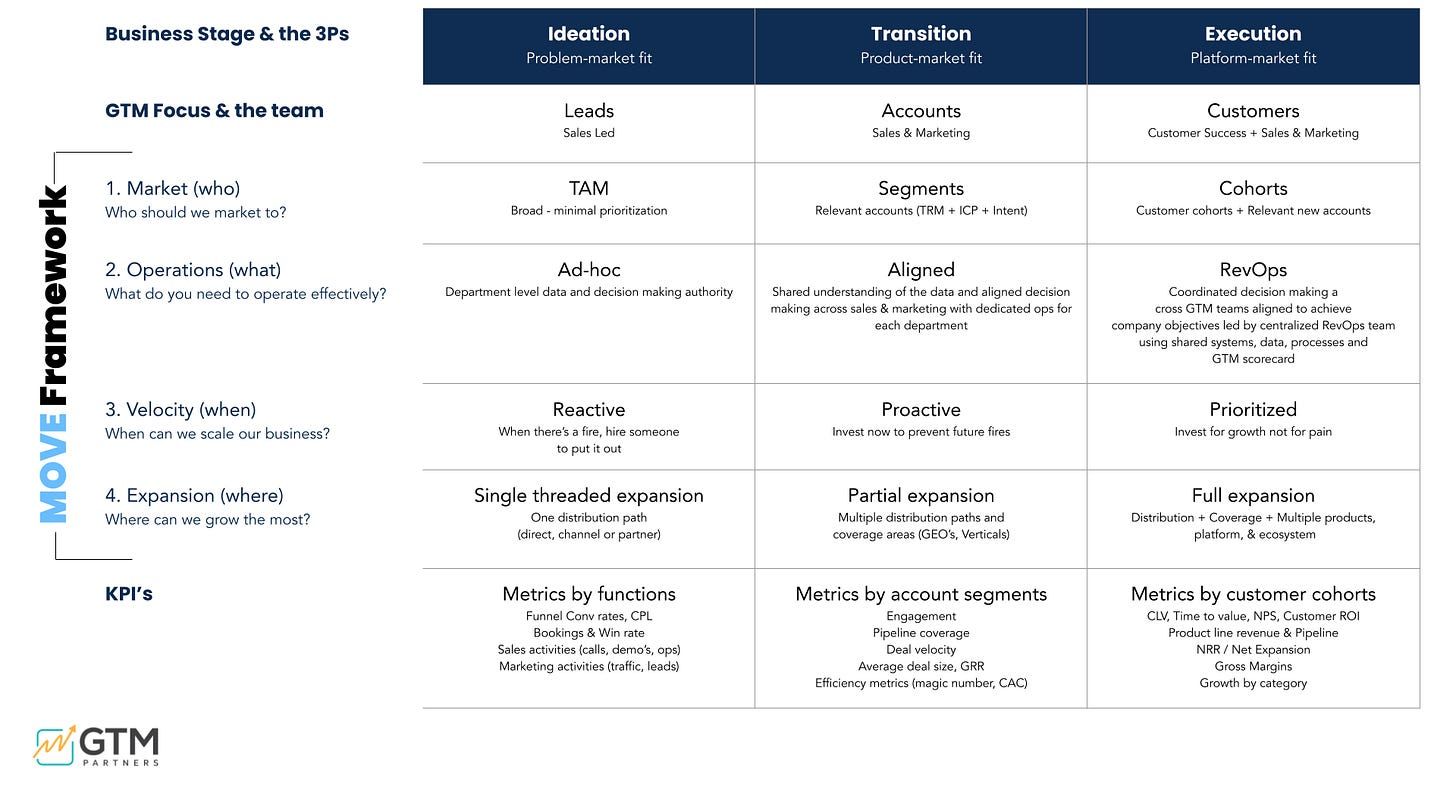
The MOVE Framework Diagnostic Matrix
Business Growth Stages (3Ps) × 4 MOVE Questions (M-O-V-E) × Operational KPIs
Case Study: $40M Services Business MOVE Alignment
Executive team dot-voting diagnostic uncovering cross-functional stage misalignment between Ideation, Transition, and Execution.
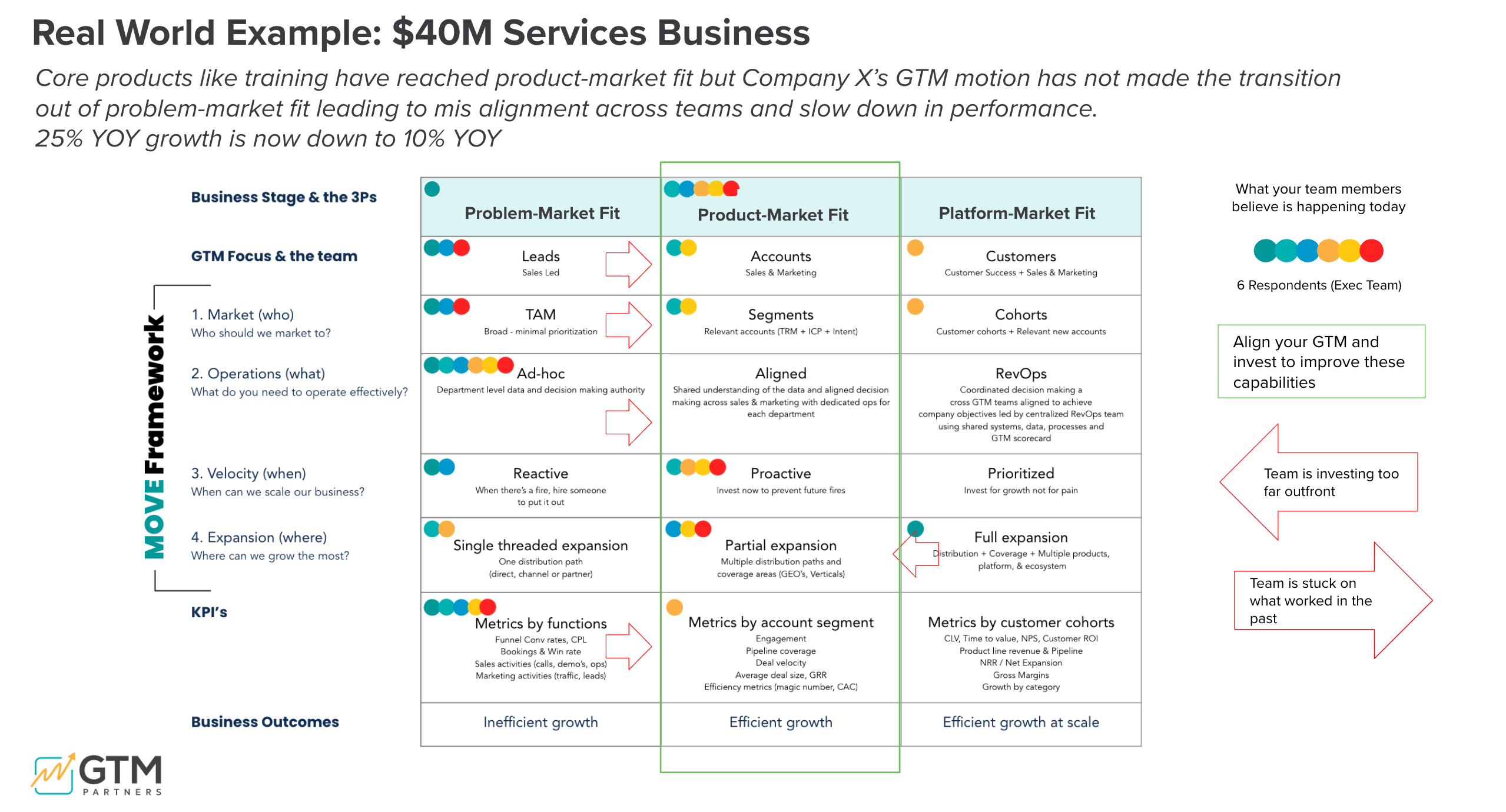
Figure: Live diagnostic heatmap showing leadership disagreement on Market, Operations, Velocity, and Expansion maturity.
The Core Stakeholder Roles in GTM Transformation
GTM breakdowns are rarely caused by a lack of effort. They happen when stakeholders step outside their natural roles or leave critical functions unowned. Effective GTM requires clear division between executive governance and functional operational leadership.
The 4 Executive Leadership Archetypes
Investors & Board
Coach the executive team through the 3Ps maturity stages without forcing growth-at-all-costs metrics that mismatch the current stage.
Chief Executive Officer
Own the company-wide GTM operating process. GTM cannot be delegated to sales or marketing; it is the CEO’s central growth discipline.
Chief Marketing Officer
Deliver a unified brand experience and point of view that generates high-intent pipeline across the entire revenue flywheel.
Chief Revenue Officer
Deliver a connected customer journey across Sales and Customer Success, optimizing acquisition, retention, and expansion.
Critical GTM Function Leaders
These leaders make the GTM operating process work across the full customer lifecycle. They partner with the Owner, Galvanizer, and Orchestrator to bring customer, product, and GTM performance data into every major decision.
Customer Leader
Owns the post-sale customer experience—ensuring the company retains, grows, and learns from the customers it acquires. Brings customer health, adoption, retention, and expansion signals back into GTM decisions.
Product Leader
Connects market and customer insight to product strategy, roadmap priorities, packaging, and value delivery. Ensures the company is building products that create meaningful customer value in its priority segments.
Revenue Operations Leader
Owns the shared GTM data, systems, processes, and scorecard that give leaders a single source of truth. RevOps should operate with enough independence to surface what is—and is not—working across Marketing, Sales, Customer Success, and Product.
Enablement Leader
Translates GTM strategy into consistent execution by equipping teams with the knowledge, tools, and reinforcement required to adopt new motions, messages, and operating processes.
Mastering Velocity Ramps & Expansion Paths
Velocity and Expansion are where most scaling companies get stuck. Companies often attempt to scale headcount before proving velocity, creating severe operational drag.
The 2 Velocity Ramps
Velocity is not simply "closing faster." It is governed by two interconnected ramps that must be solved together:
- The People Ramp: How quickly a new hire reaches full productivity and quota attainment.
- The Enablement Ramp: How consistently marketing, sales, and CS execute shared playbooks and messaging.
The 3 Expansion Paths
Sustainable enterprise value requires identifying the right expansion path for your current maturity stage:
- Sales Expansion: Selling more licenses, tiers, or usage into existing accounts.
- Coverage Expansion: Expanding into new buyer personas, verticals, or geographic territories.
- Solutions Expansion: Launching complementary products and platforms to expand TAM.
From MOVE Mindset to GTM Operating System Execution
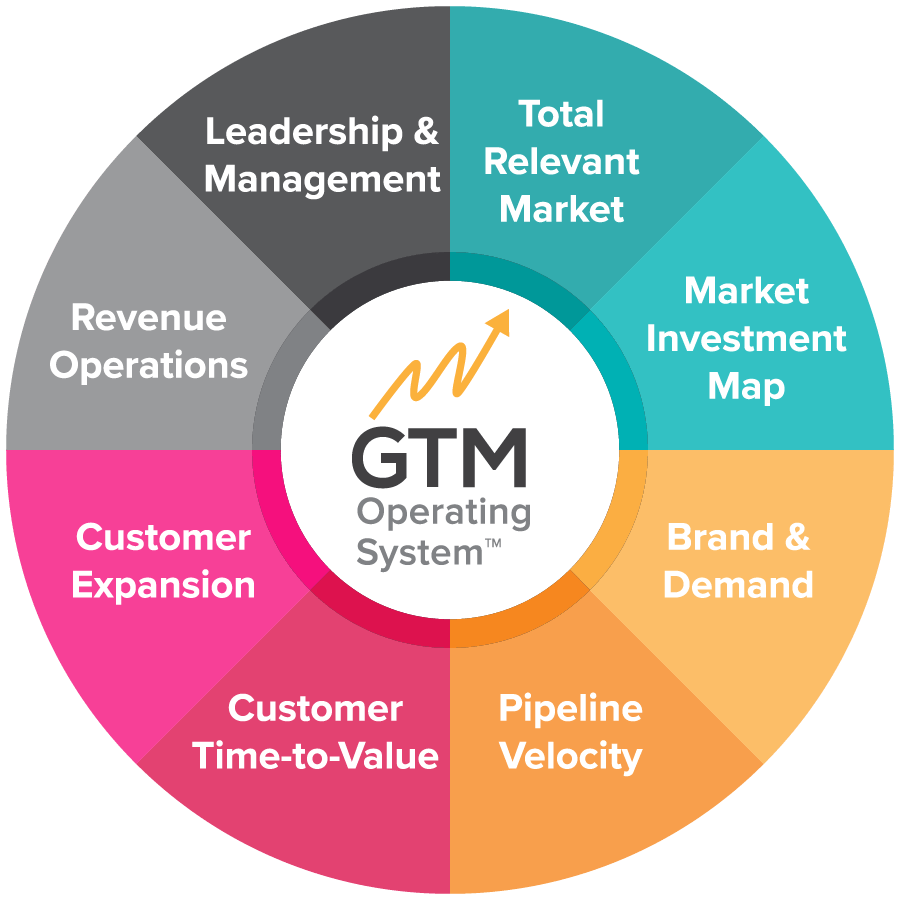
MOVE provides the diagnostic framing and strategic clarity. However, strategic clarity without an operating system leads to execution drag. To bring the MOVE framework to life, leadership teams install the GTM Operating System™ (GTM OS) across their organization.
Ready to translate MOVE into an operating rhythm?
Explore how the 8 Pillars of GTM OS operationalize Market, Operations, Velocity, and Expansion into daily cadences and executive scorecards.
MOVE: The 4-Question Go-to-Market Framework
Authored by GTM Partners co-founders Sangram Vajre and Bryan Brown, MOVE has become the standard operating playbook for thousands of CEOs, CROs, and revenue leaders navigating growth transitions.
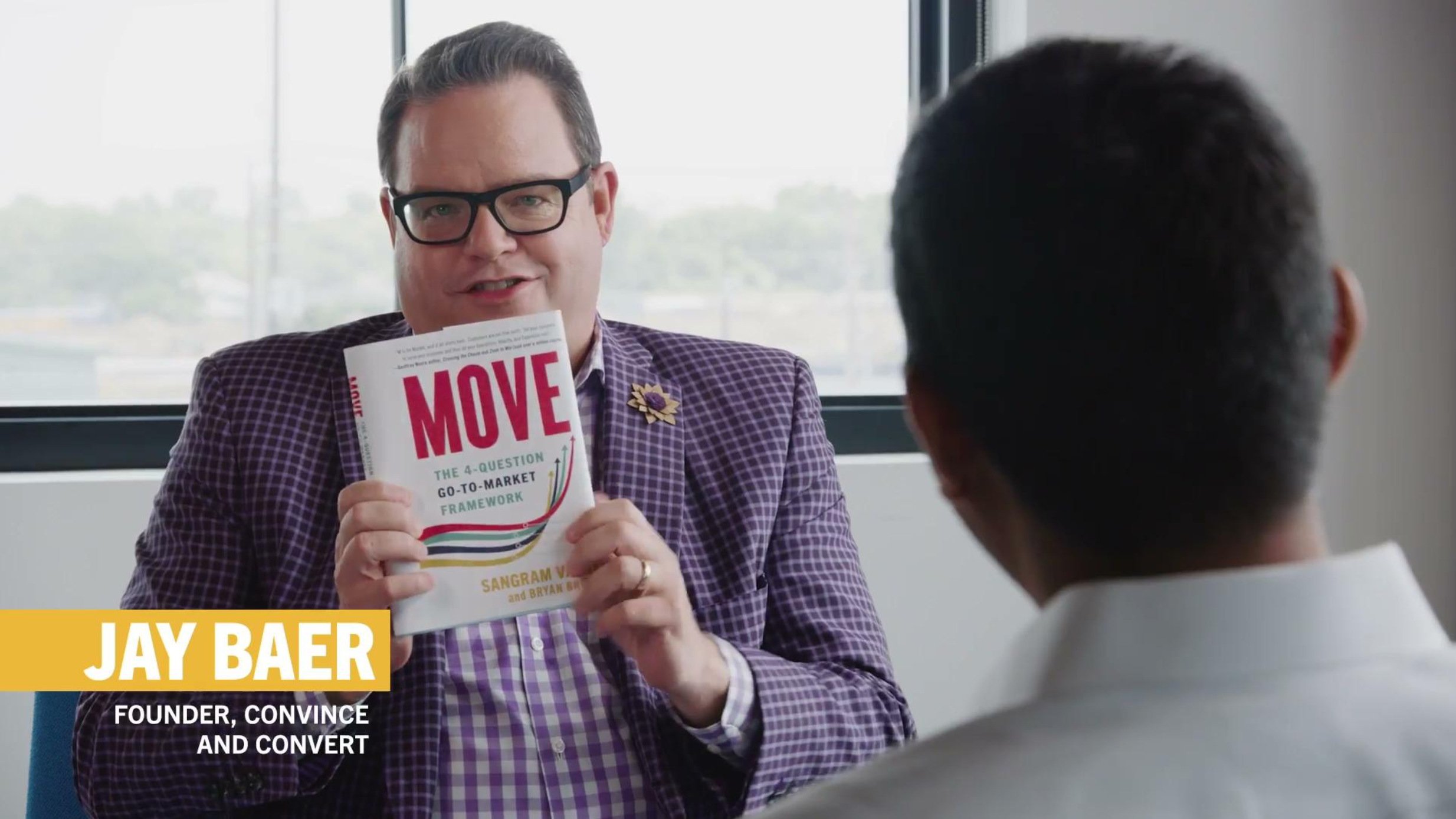
“If you want your go-to-market to actually work across every department, read MOVE. It’s the definitive playbook for modern B2B leaders.”— Jay Baer, Hall of Fame Keynote Speaker & Bestselling Author
Endorsed by the World’s Leading GTM CEOs & Investors
From tech founders and public company CEOs to premier venture partners, discover why top revenue leaders consider MOVE the definitive operating manual.
“M is for market, and it all starts here. Set your compass to serve your customer and then let your operations, velocity, and expansion roll!”
"Go-to-market is like a product, and this book nails it with the MOVE framework."
"It hooked me immediately. The MOVE framework will make every revenue leader smarter and better."
"Your next MOVE is in this book, and it answers the questions every high-performing revenue team must answer."
"MOVE is the blueprint for modern go-to-market companies, with customers at the center of it."
"MOVE is the framework for turbo-scaling your business."
"The ultimate go-to-market bible for every stage of your business."
"MOVE is the operating manual for all go-to-market leaders."
What Leaders & Practitioners Are Saying on Amazon
"The definitive playbook for modern revenue teams"
MOVE takes the chaotic world of go-to-market and turns it into a clear, repeatable science. The four questions forced our executive team to stop debating opinions and finally agree on our Total Relevant Market. A masterclass for any CEO, CRO, or board member.
"Finally, a framework that aligns Sales, Marketing, and Customer Success"
Most business books give you high-level inspiration. MOVE gives you an operational blueprint. The flight metaphor hit home immediately—launching is easy, but sustained flight requires an operating system. This book is required reading for our entire leadership team.
"Eliminated months of executive misalignment"
We used the 3Ps (Ideation, Transition, Execution) to diagnose exactly where our company was stalled. Realizing we were trying to run platform-stage motions while still in transition saved us hundreds of thousands of dollars in wasted marketing spend.
"Throw out the traditional funnel—this is the new model"
Sangram and Bryan have distilled decades of experience into 200 pages of pure gold. The truth about RevOps being the single source of truth and customer retention being the new acquisition completely changed how we structure our revenue operations.
"Actionable, pragmatic, and zero fluff"
I’ve read dozens of business books that could have been a blog post. MOVE is the opposite—dense with diagnostic scorecards, real-world case studies, and clear steps. It’s sitting on my desk dog-eared and highlighted. I send a copy to every portfolio CEO.
"Transformed how our C-suite plans our next move"
The four questions (Market, Operations, Velocity, Expansion) seem deceptively simple until you try to answer them as an executive team. Answering them gave us total clarity on where to invest and what to stop doing immediately.
Run the MOVE Assessment with Your Leadership Team
Work with a certified GTM OS partner to run a facilitated MOVE diagnostic workshop, identify stage misalignment across Marketing, Sales, and CS, and build your 90-day operating roadmap.