Pipeline VelocityWhich GTM motions get you to your revenue goal faster?
A CEO’s guide to turning disconnected sales tactics into an explicit Revenue Model Playbook, measuring velocity by motion, and eliminating accidental growth.
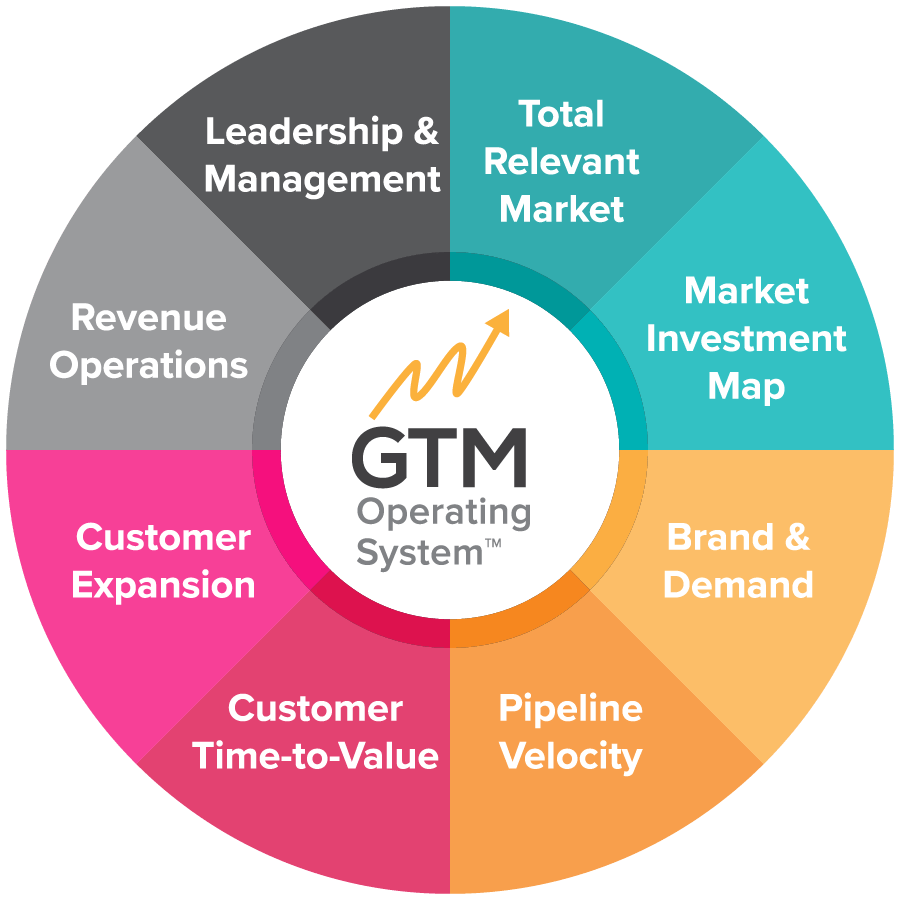 GTM OS™ Framework
Most B2B companies do not miss their revenue numbers because their sales reps lack effort or their marketing team is not running campaigns.
They miss their targets because growth has become accidental.
As companies scale, they accumulate products, segments, and channels without designing the underlying mechanics of how each one converts. Headcount grows faster than revenue efficiency; leaders spend hours inspecting individual deals on CRM dashboards; and executive teams debate tactical symptoms rather than fixing broken systems.
Pillar 4 of the GTM Operating System — Pipeline Velocity — establishes the Revenue Model Playbook that transforms accidental growth into an intentional, repeatable engine.
Why Revenue Breaks: The Accidental Growth Trap
In our research studying B2B revenue organizations, we see executive teams struggle with the same recurring symptoms:
- •Cross-Functional Thrash: Marketing, Sales, Product, and Customer Success are working hard, but pulling in different directions.
- •Onboarding Lag: New account executives take nine months to ramp because nobody can clearly articulate what “good” looks like in their specific territory.
- •Headcount Without Efficiency: Adding 30% more sales reps only yields 10% more bookings because pipeline friction remains unaddressed.
- •Inspection Over Insight: Forecast meetings turn into stressful interrogations of sales reps rather than evaluations of commercial systems.
What is missing is not more tooling or more inspection. What is missing is an explicit, shared operating model for how revenue actually flows through the business.
“Growth does not come from doing more things. It comes from deliberately designing and running the right revenue motions well.”
What Is a Revenue Motion?
A Revenue Motion is not a marketing campaign, a sales methodology (like MEDDIC or Challenger), or a CRM dashboard.
A Revenue Motion is a deliberately designed, end-to-end commercial system that connects a specific segment and ICP to a specific product, using a GTM motion designed for that context, with clear executive ownership.
For example, “Outbound” is not a revenue motion. Outbound for Enterprise Financial Services selling Core Platform with multi-threaded executive alignment is a revenue motion. High-velocity Outbound for Mid-Market Tech selling an add-on module is a completely different revenue motion with different conversion rates, sales cycle lengths, and rep skill sets.
Why Funnels Fail in Modern B2B
Traditional funnel models assume a single buyer journey: a lead enters the top, gets qualified by marketing, passes to sales, and converts at predictable stage rates.
In reality, modern B2B companies operate in a multi-motion world. You might have an enterprise motion with a 180-day cycle running alongside a self-serve PLG trial and a partner referral channel.
Funnels describe volume; Revenue Motions explain mechanics. Blending all leads into one monolithic funnel hides where commercial friction actually sits.
Measuring Pipeline Velocity by Revenue Motion
Pipeline velocity measures how quickly pipeline dollars turn into realized revenue:
The Critical Rule: Measuring velocity as a blended company-wide number is useless. A high-velocity mid-market motion will mask a stalled enterprise motion. Velocity must be calculated and tracked separately for each active revenue motion.
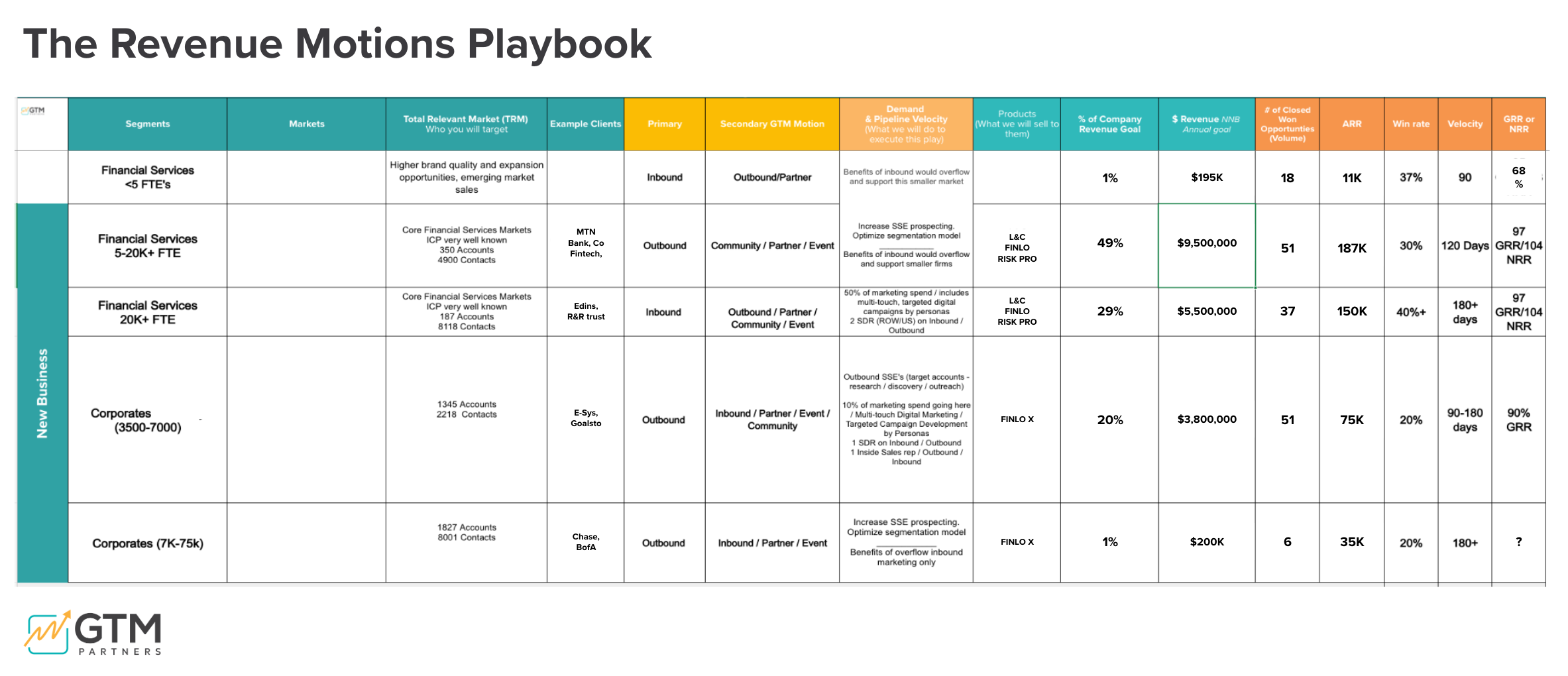
Designing the Revenue Model Playbook
The Revenue Model Playbook is not shelf-ware documentation. It is an executive decision system that brings together the first four pillars of the GTM Operating System:
How the Playbook Connects the First 4 Pillars of GTM OS:
Historical Economics: What Deserves to Scale
A revenue motion can close deals, generate bookings, and hit quarterly sales targets — and still be a terrible long-term investment.
Durable scale is determined by historical economics by motion:
- • Net Revenue Retention (NRR): Does revenue in this motion compound over time (> 110%)?
- • Gross Revenue Retention (GRR): Do customers acquired through this motion renew predictably?
- • Customer Acquisition Cost (CAC) Payback: Does the payback period fall under 12–15 months?
- • Gross Margin: Does servicing this motion strengthen or drain gross margins?
Growth that does not compound is not growth. It is churn in disguise.
How Companies Implement Pipeline Velocity
Pipeline Velocity and the Revenue Model Playbook transform commercial strategy into a living operating cadence for the CEO, CRO, CMO, and RevOps leadership.
Working with a Certified GTM OS Partner helps executive teams map their revenue motions, identify low-velocity bottlenecks, align sales comp and capacity, and lock in the 90-day execution rhythm.
Engage a Certified GTM OS Partner for Pillar 4 (Pipeline Velocity):
- • Revenue Motions Mapping Sprint: Audit and explicitly define all active revenue plays across the business.
- • Velocity & Economics Diagnostics: Calculate win rates, deal sizes, cycle lengths, and NRR by individual motion.
- • Sales Design & Quota Alignment: Match seller skill sets, compensation plans, and territory capacity to active motions.
- • Weekly Playbook Cadence: Install the weekly revenue motions rhythm across marketing, sales, and RevOps.
What Executive Teams Say About Pipeline Velocity
Perspectives on using the Revenue Model Playbook to focus the business on the GTM motions that matter most—and improve how revenue moves through the system.
"One of the biggest realizations for me was that growth isn't just about doing more things — it's about limiting how many fundamentally different motions the company is trying to run at once. This process made us confront the switching costs between motions and decide which ones we're truly going to build."
"What Pipeline Velocity did for us was connect our marketing work directly to how revenue actually flows through the business. Instead of just generating activity, we're now aligning marketing to the specific revenue motions that drive growth."
"The biggest change for us was moving from analyzing where revenue came from historically to designing where we want revenue to come from. Once we defined the revenue motions, the segments they serve, and how production supports them, the growth model became much clearer."
Ready to Accelerate Your Revenue Motions?
Connect with a Certified GTM OS Partner to build your Revenue Model Playbook, measure velocity by motion, and eliminate accidental growth across your sales engine.