GTM PlanningConnect strategy to a 90-day operating rhythm
GTM Partners’ flagship executive engagement for turning annual revenue goals into cross-functional alignment, a single-slide operating blueprint, and a 90-day roadmap that actually gets executed.
 GTM OS™ Framework
Every year, leadership teams spend weeks in offsites and budget meetings building strategic plans. The CEO and board set a top-line growth target: 3x pipeline, 30% ARR growth, 115% Net Revenue Retention.
Then the executive team does the math: how many leads does Marketing need to generate? How many reps does Sales need to hire? How many customer success managers are required to support the new volume?
By February, reality sets in. Marketing hits its MQL number, but the leads are bad-fit accounts. Sales misses quota because pipeline velocity stalls. Customer Success struggles with churn because product promises were oversold. And the executive team meets each month to debate why the spreadsheet isn’t matching the scoreboard.
A revenue target is not a strategy. And spreadsheets are not an operating system.
Five Ways Strategic Planning Breaks Down
In our research studying hundreds of B2B go-to-market teams, strategic planning failures rarely stem from a lack of intelligence or ambition. They stem from predictable cognitive and organizational biases:
1. “Mathism” — Believing You Can Spreadsheet Your Way to Growth
Multiplying historical conversion rates against higher lead targets ignores market saturation, pipeline decay, and team capacity. When the math doesn’t work in the market, teams cut corners, discount prices, and damage unit economics.
2. Functional Siloing — Planning by Department Instead of by Customer
Marketing plans campaigns, Sales sets territory quotas, Product builds features, and Customer Success manages onboarding. Each team builds an isolated plan with separate assumptions, leaving the critical handoffs unmanaged.
3. Confusing Frantic Activity With Progress
Without clear alignment on the single biggest constraint in the business, every department launches its own high-priority initiatives. The company ends up with 40 simultaneous projects, exhausted teams, and no measurable improvement in key outcomes.
4. Lagging-Indicator Obsession
Tracking revenue and ARR numbers tells you what happened in the past, not whether your current GTM motions are working today. Without leading indicators tracked across the full customer journey, risk only becomes visible after the quarter is missed.
5. The Failure of Subtraction
Most planning processes are additive: more campaigns, more reps, more features, more markets. True strategy is subtraction. The clarity of deciding what the company will not do is what gives your primary priorities their power.
“Annual planning should start with strategic tradeoffs at the executive level long before discussing how many reps to hire or how much to spend on ads.”
GTM Planning: GTM Partners’ Flagship Executive Product
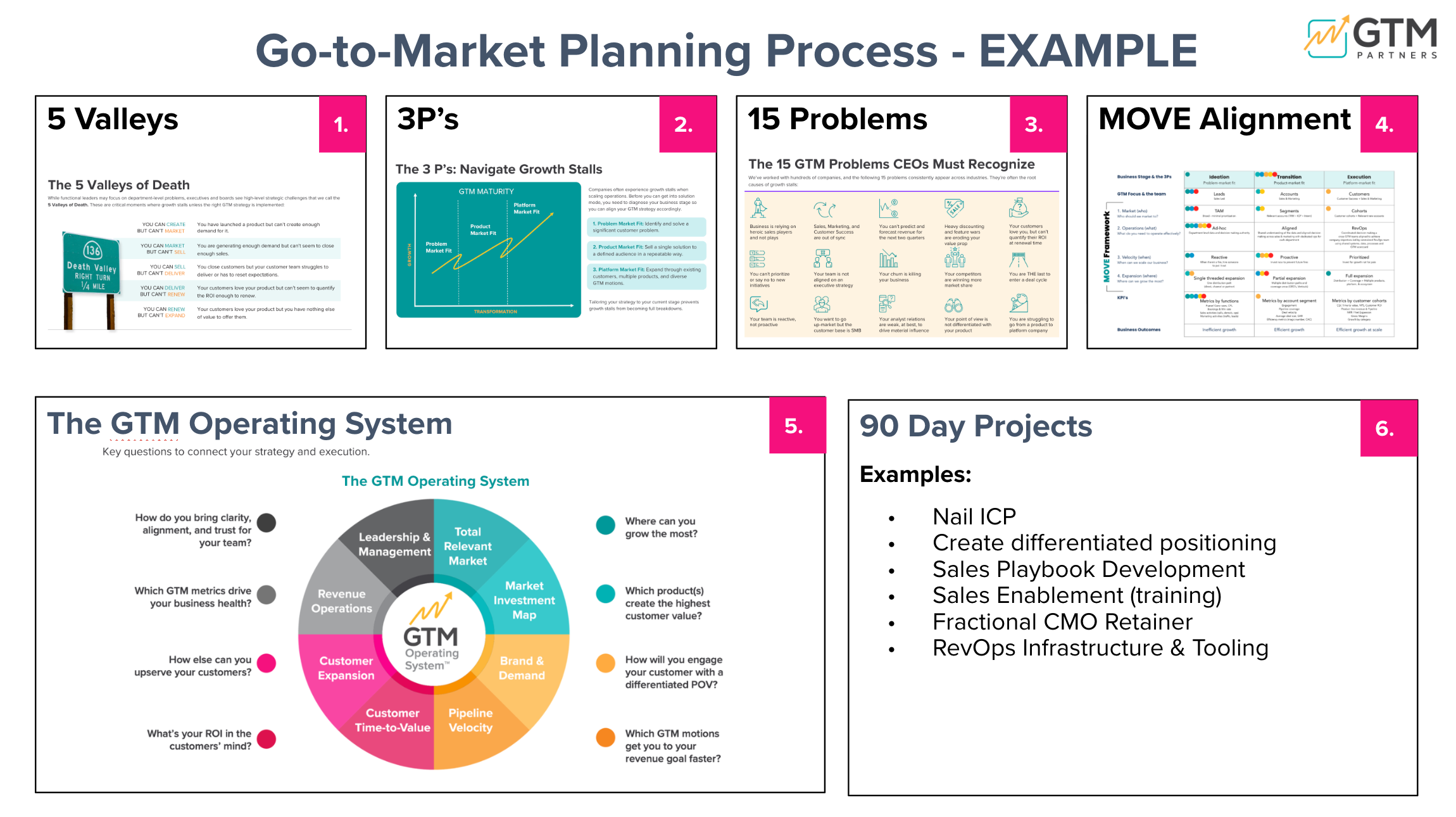
GTM Planning™ is not a generic brainstorming exercise. It is GTM Partners’ flagship executive product — a proprietary commercial alignment and diagnostic methodology built to help executive teams diagnose their true growth constraints, align across all five functions, and lock in an executable 90-Day GTM Operating Plan.
Developed by GTM Partners through direct research with hundreds of B2B executive teams and delivered exclusively through Certified GTM OS Partners, GTM Planning is designed as a standardized, high-value quarterly operating sprint.
Over five focused 90-minute executive working sessions (or a single 1-day onsite), an experienced Certified Partner guides the CEO, CMO, CRO, CPO, CCO, and RevOps leadership through proven diagnostic frameworks to produce two permanent operating assets:
The GTM OS on a Slide
The single-page commercial blueprint that captures your business stage, target market, priority products, active revenue motions, and key metrics in one shared view.
The 90-Day GTM Roadmap
A prioritized, sequenced project list with clear executive owners, key milestones, and explicit agreements on what the company will stop doing over the next 90 days.
GTM Planning is not about writing a 60-page deck that gets archived after an executive retreat. It is about facilitating the tough, essential alignment conversations that leadership teams need to have before committing capital, headcount, and resources.
Four Diagnostic Lenses That Drive GTM Planning
Rather than relying on subjective opinions or loud voices in the boardroom, GTM Planning uses four research-backed diagnostic lenses created by GTM Partners to structure executive decision-making:
The 5 Valleys of Death
Identifies the exact bottleneck where commercial momentum stalls across the customer journey:
- • 1. You can CREATE but can’t MARKET: You have launched a product but can’t create enough demand for it.
- • 2. You can MARKET but can’t SELL: You are generating enough demand but can’t seem to close enough sales.
- • 3. You can SELL but can’t DELIVER: You close customers, but your team can’t consistently fulfill, implement, or support what was promised in the deal.
- • 4. You can DELIVER but can’t RENEW: Your customers love your product but can’t seem to quantify the ROI enough to renew.
- • 5. You can RENEW but can’t EXPAND: Your customers love your product but you have nothing else of value to offer them.
The 3 Ps of Growth (GTM Maturity Stage)
Determines whether your company is operating in Problem-Market Fit, Product-Market Fit, or Platform-Market Fit. Running Platform-stage motions with Product-stage economics is one of the most common causes of wasted capital.
The 15 GTM Problems Framework
Cuts through hundreds of noisy symptoms (e.g., “sales reps need more training,” “we need more ad budget”) to isolate the top three structural root causes holding growth back.
The 8-Pillar GTM Operating System™
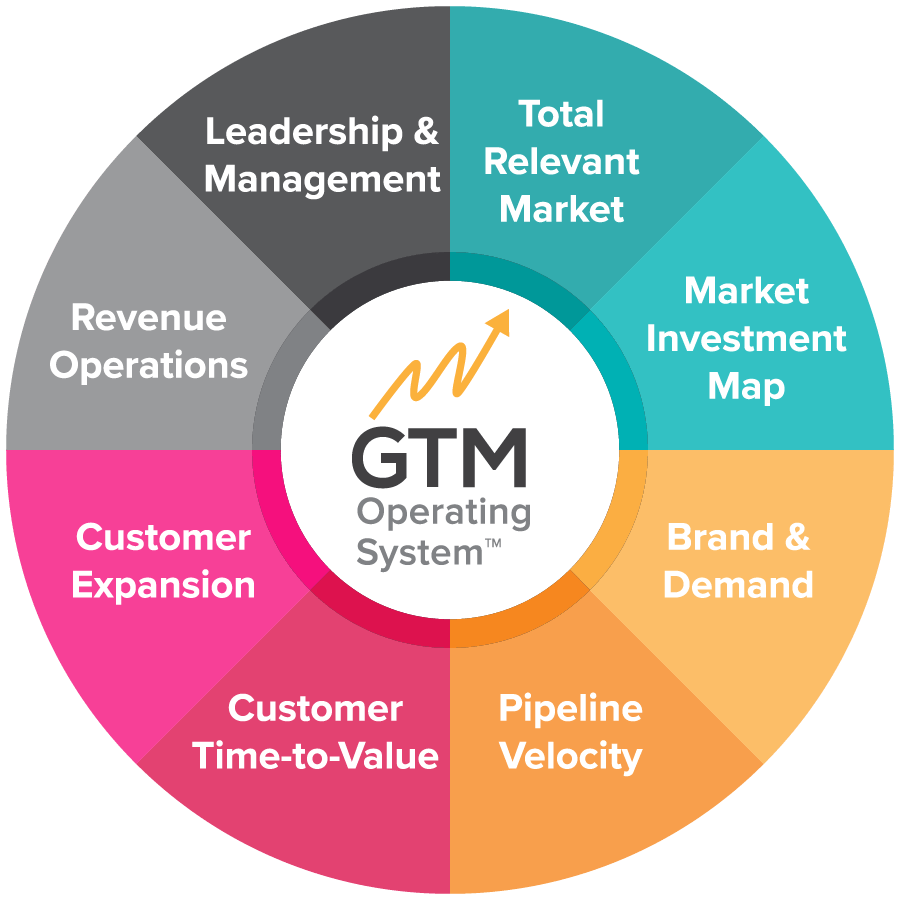
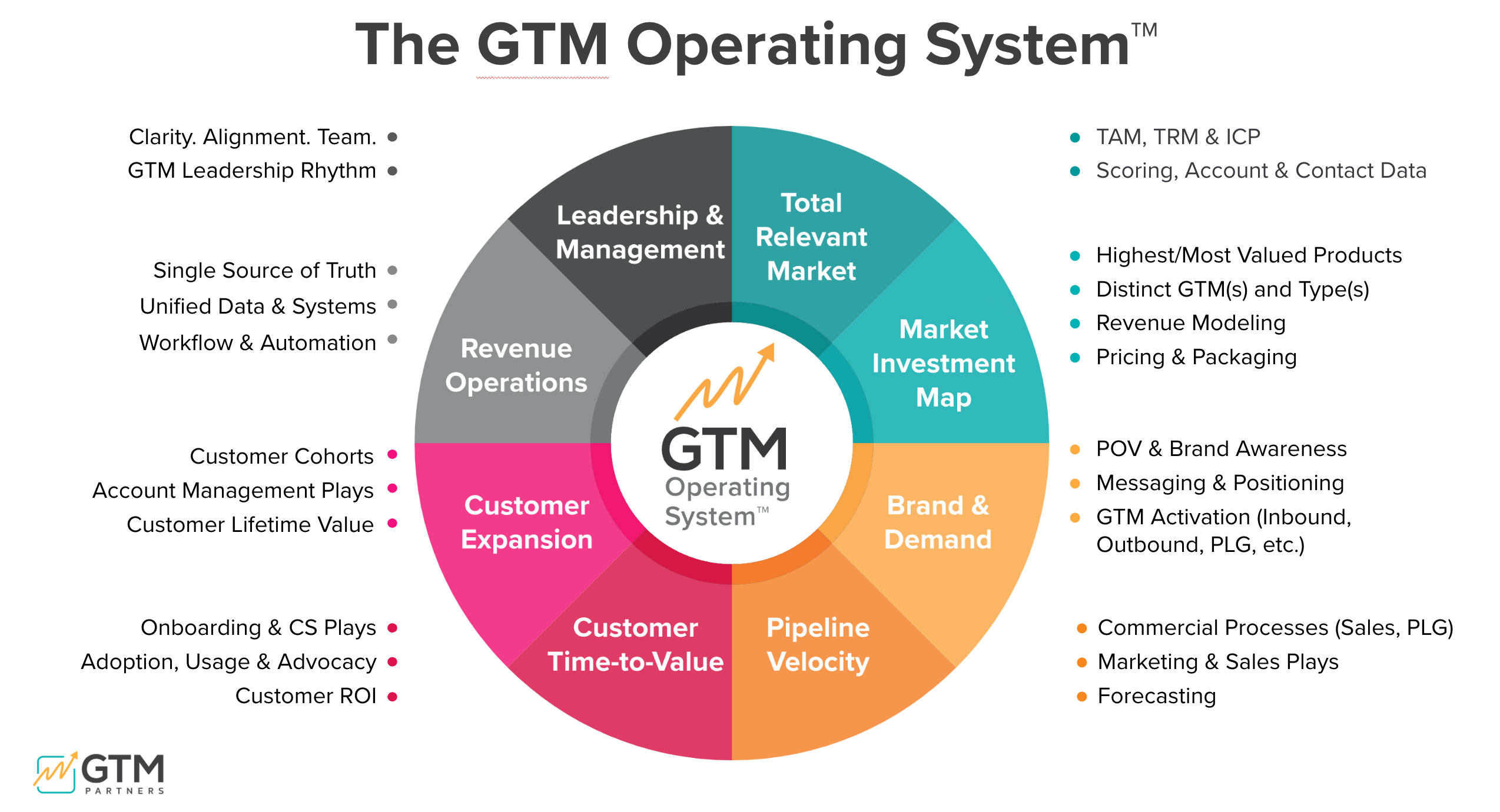
Answers the 8 diagnostic questions to map TRM, Market Investment, Brand & Demand, Pipeline Velocity, Time to Value, Expansion, RevOps, and Leadership into one synchronized blueprint.
The 5-Session Executive Working Cadence
GTM Planning is structured for busy executive teams (5 to 10 leaders). Delivered over 2 to 3 weeks across five 90-minute interactive working sessions (or a single 1-day onsite), every session is facilitated by a Certified GTM OS Partner to produce concrete decisions:
Kickoff, Growth Goals & The 5 Valleys of Death
Anchor on top-line business goals, evaluate where current growth friction sits across Awareness, Conversion, Delivery, Retention, and Expansion, and initiate the executive GTM Assessment across the leadership team.
GTM Assessment Readout, 3Ps Maturity & Problem Selection
Review GTM Assessment results to expose divergence in perspective across the leadership team. Determine the company’s 3Ps maturity stage and select the top 3 GTM problems to solve.
Live Mapping: GTM OS on a Slide — Part 1 (Market & Strategy)
Walk through the first four GTM OS pillars live: Total Relevant Market (TRM), Market Investment Map (MIM), Brand & Demand (B&D), and Pipeline Velocity (PV). Align on target ICPs, product prioritization, and revenue motions.
Live Mapping: GTM OS on a Slide — Part 2 (Execution & Operations)
Walk through the remaining four pillars: Customer Time to Value (TTV), Customer Expansion (CE), Revenue Operations (RevOps single source of truth), and Leadership & Cadence (LM).
Executive Readout & 90-Day Roadmap Lock-In
Deliver the final GTM Planning Readout, lock in the 90-Day GTM Roadmap with designated executive owners and milestone dates, agree explicitly on deprioritized projects, and establish the executive operating cadence.
What the Executive Team Walks Away With
At the conclusion of GTM Planning, leadership receives four permanent operating assets that govern commercial execution:
1. GTM OS on a Slide
A clear, executive-level one-page snapshot capturing market focus, product priority, revenue motions, unit economics, and 8-pillar alignment.
2. 90-Day GTM Roadmap
A sequenced project backlog with designated executive owners, leading-indicator milestones, and explicit agreements on what projects are deprioritized.
3. GTM Diagnostic Readout
An objective synthesis of company maturity (3Ps), active Valleys of Death, and assessment pattern analysis detailing where cross-functional alignment broke down.
4. Execution & Pillar Scope
A clean division of responsibilities defining which roadmap initiatives will be run internally vs. where specialized Certified GTM OS Partner support is required.
Why Modern GTM Runs on a 90-Day Planning Rhythm
Annual planning cycles are too slow for fast-moving B2B markets. By the time Q3 arrives, market dynamics, competitive pressures, and product capabilities have completely changed.
Conversely, monthly planning is too reactive, causing teams to thrash between disjointed short-term tactics without finishing high-impact work.
90 days is the sweet spot for modern go-to-market execution. It is long enough to complete meaningful structural projects (such as launching a new revenue motion or overhauling customer onboarding) and short enough to test assumptions before capital is wasted.
The Complete GTM Operating Cadence
“GTM Planning turns annual strategic ambition into a repeatable 90-day execution rhythm that keeps executive teams aligned, accountable, and agile.”
How Companies Put GTM Planning Into Practice
GTM Planning is a standardized product created by GTM Partners and facilitated by Certified GTM OS Partners — seasoned former CEOs, CMOs, CROs, and CCOs with deep operational experience.
Having an outside executive operator in the room creates the psychological safety and objective rigor needed to surface disagreements, challenge pet projects, and build consensus around what actually matters.
How to Engage a Certified GTM OS Partner for GTM Planning:
- •90-Minute GTM Transformation Workshop: A focused diagnostic session to assess stage, surface misalignment, and identify priority bottlenecks before planning.
- •Full GTM Planning Sprint: Five 90-minute executive working sessions (or a 1-day onsite) producing the GTM OS on a Slide and 90-Day GTM Roadmap.
- •Quarterly Planning Retainer: A recurring 90-day cadence that continuously resets priorities, evaluates leading indicators, and keeps strategy connected to execution.
What Executive Teams Say About GTM Planning
Perspectives from CEOs and revenue leaders on breaking annual drift with 90-day operating discipline.
"As a CEO, you live in a world of too many opportunities and not enough clarity. The GTM Operating System cuts through that noise, giving you a single, proven framework to align your executive team, narrow your focus, and finally build the kind of predictable, scalable growth that lasts."
"We had strategy documents and we had ICP models, but GTM Planning exposed something uncomfortable: the strategy wasn't actually embedded in how the company operated. That gap between strategy and execution is where most companies get stuck in the Valleys of Death."
"If you asked five leaders in the company to pull up the ICP, you'd find five different documents. GTM Planning helped us create one shared go-to-market language and one version of the truth."
"What GTM Planning did for us was create discipline. Instead of constantly changing metrics and chasing every initiative, we aligned around a few core indicators of business health and committed to operating the company around them."
Ready to Lock In Your Next 90-Day GTM Plan?
Connect with a Certified GTM OS Partner who can facilitate your executive team through the GTM Planning process and build your 90-Day Operating Roadmap.