
The 3Ps FrameworkProblem-Market Fit → Product-Market Fit → Platform-Market Fit
Identify the stage your business is actually in so your go-to-market strategy matches the company you have — not the company you hope to become.
 Framework Library
Why Revenue is a Deceptive Stage Indicator
The 3Ps Framework, created by GTM Partners and first introduced in our Wall Street Journal bestselling book MOVE: The 4-Question Go-to-Market Framework, categorizes business maturity by the behavioral repeatability of your go-to-market system. When a company moves into a new stage but continues executing with the habits and expectations of a prior stage, it experiences a Stage Mismatch Drag that frequently turns into a severe growth stall.
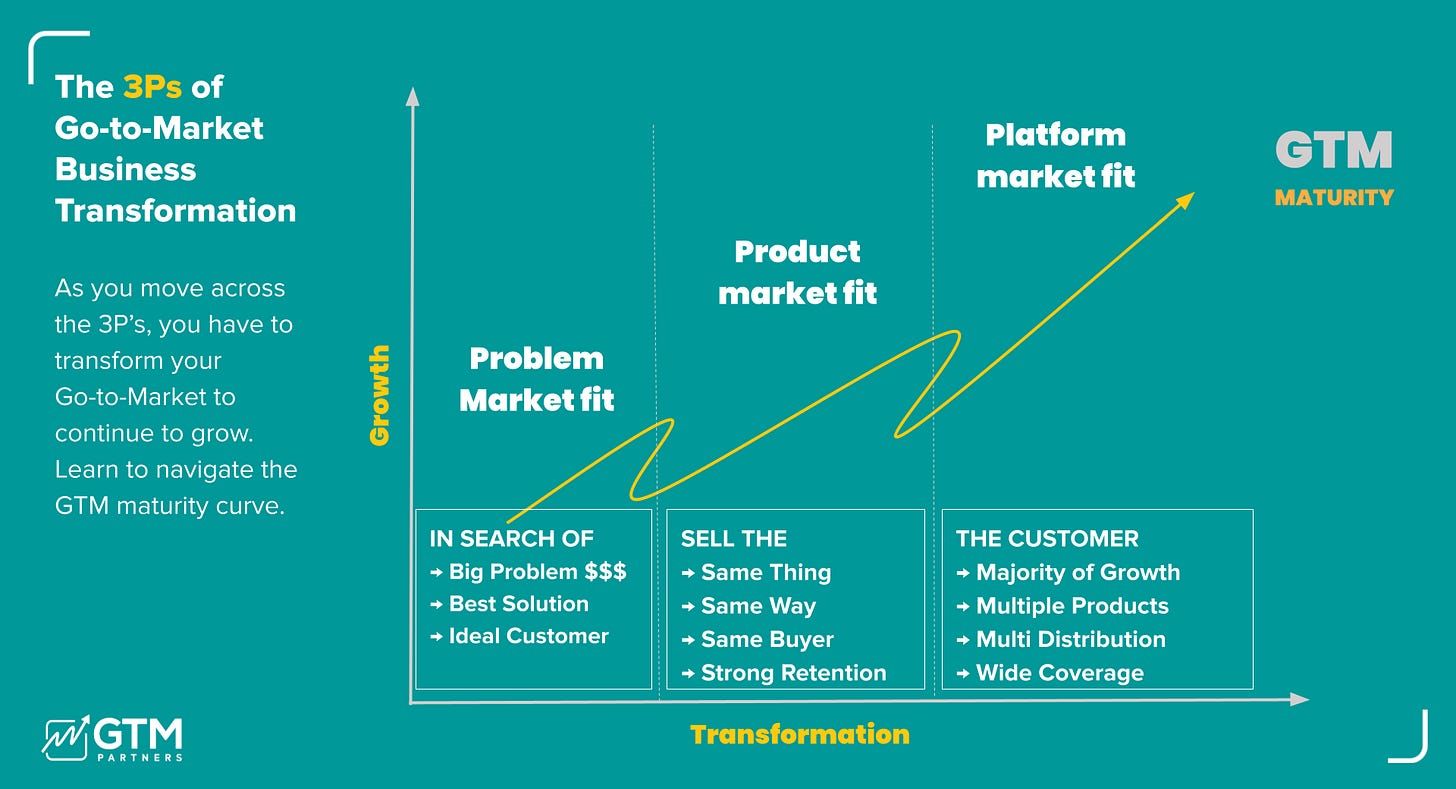
Problem-Market Fit
Are we searching for a big enough problem and willing buyer?
Core Operating Realities:
- Searching for a painful, valuable problem that buyers will pay to solve.
- Broad testing across messaging, pitches, audiences, and pricing.
- Sales-led and founder-driven; team experimentation is necessary.
- Low repeatability; still discovering what matters most to buyers.
Product-Market Fit
Can we sell the same thing, to the same buyer, the same way, and retain them?
Core Operating Realities:
- Proven repeatability across one core product offer and one dominant buyer persona.
- Sales cycles become predictable; win rates and conversion stabilize.
- Customer retention and initial Time-to-Value become essential proof points.
- Shift from broad experimentation to disciplined ICP execution.
Platform-Market Fit
Is existing customer expansion the primary growth engine of the company?
Core Operating Realities:
- Customer base becomes the majority driver of total net new revenue (NRR > 110%).
- Multiple products, cross-sell motions, and multi-distribution channels.
- Ecosystem and partner network actively source and accelerate enterprise deals.
- GTM operates as an enterprise operating system with centralized RevOps.
How Do You Know If You Have Product-Market Fit? The 4 “Sames” of GTM Repeatability
In early-stage technology, founders are often told: “Just build something people love.” But in B2B, a great product alone does not scale. You can have 50 happy customers who bought for 50 different reasons, customized the deliverable, and closed only because the founder jumped on the pitch. That is not Product-Market Fit—it is bespoke services disguised as software.
In the GTM Partners taxonomy, Product-Market Fit is not an engineering milestone; it is a commercial reality. It is the transition gate where a company proves it can scale out of Problem-Market Fit without crashing into the Valley of Death. You have real Product-Market Fit only when your commercial engine proves the 4 “Sames” of GTM Repeatability simultaneously:
Same Offer
You sell a standardized product package with consistent pricing, defined scope, and measurable ROI. You are no longer conceding custom product roadmaps or one-off code tweaks to win contracts.
Same Buyer
You target a strictly defined Total Relevant Market (TRM) and a dominant buyer persona facing the exact same verified commercial bottleneck. You are no longer selling to adjacent industries or random leads that don't match your ICP.
Same Way
Your sales cycle is standardized into a repeatable motion. Quota-carrying non-founder Account Executives can consistently prospect, demo, and close deals at stable conversion rates—without executive heroics or founder-closed deals.
High Retention
Customers achieve rapid Customer Time-to-Value (TTV) and renew at high rates (Gross Revenue Retention > 90%). High retention proves that what Marketing and Sales promised was genuinely delivered by the product.
The Reality Check: What Product-Market Fit Is NOT
Premature scaling occurs when executive teams confuse early commercial traction with true Product-Market Fit. You do not have PMF simply because:
- You closed deals through personal relationships or founder hustle: That is founder-market fit. If non-founder reps cannot close the same deal using the playbook, the machine is not repeatable.
- You raised a large venture capital or private equity round: Capital is an accelerant of commercial repeatability, not proof of it. Pouring capital into an unproven motion accelerates cash burn.
- Your vanity top-of-funnel traffic or trial sign-ups are spiking: If customers churn out after 90 days (GRR < 80%), you have a leaky bucket, not Product-Market Fit.
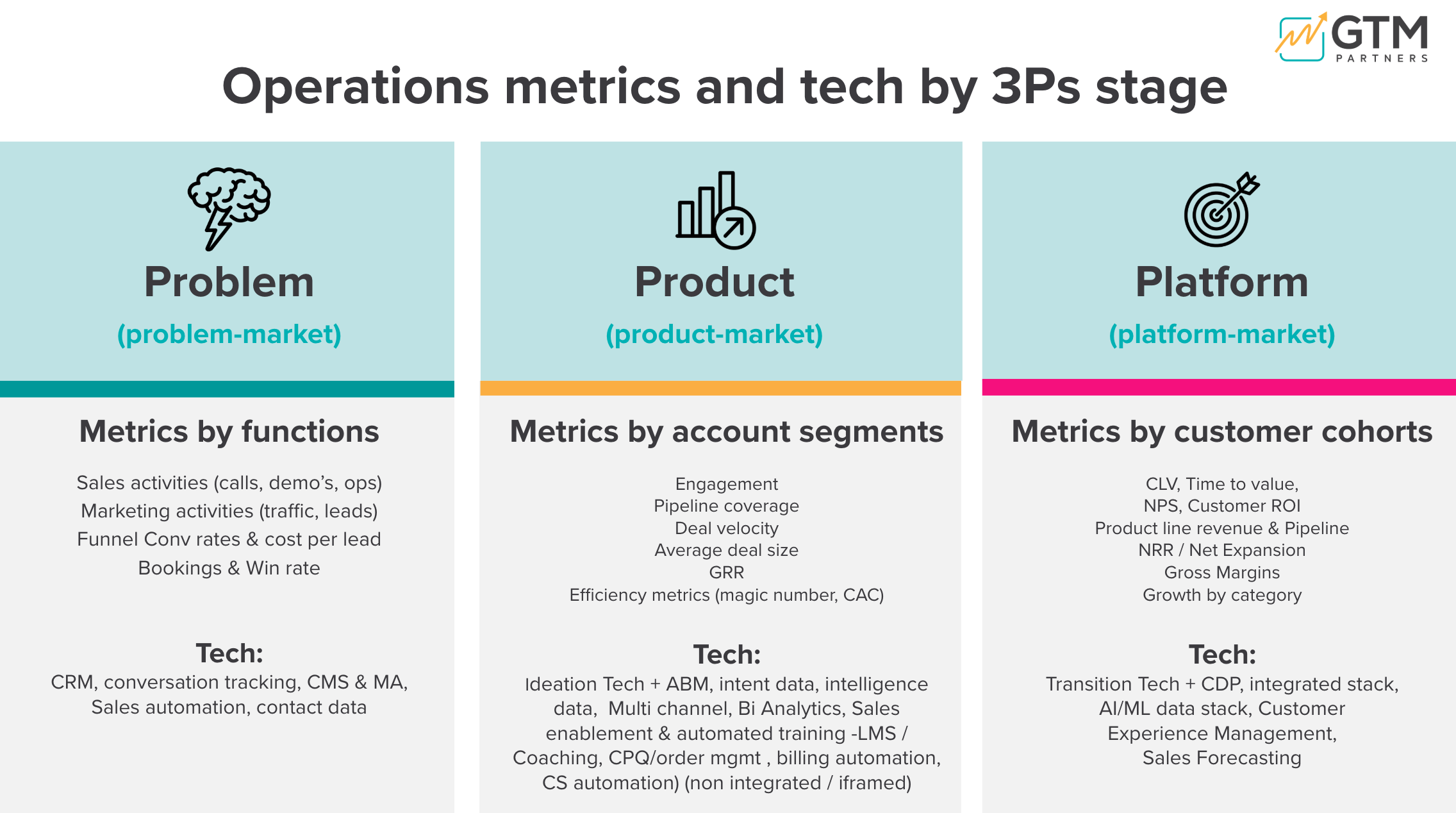
The 3Ps Operational Stage Transition Matrix
How operational realities, commercial metrics, and GTM motions evolve across the 3Ps of business maturity:
| Operational Dimension | Stage 1 • Problem-Market Fit (Ideation) | Stage 2 • Product-Market Fit (Transition) | Stage 3 • Platform-Market Fit (Execution) |
|---|---|---|---|
| Core Objective | Discover painful problem & willing buyers | Prove commercial repeatability (4 Sames) | Scale customer expansion & cross-sell |
| The 4 Sames Status | 0 Sames proven (broad testing & pivots) | All 4 Sames locked & executed predictably | Multiplied across secondary offers & motions |
| Sales Execution | Founder-led, bespoke pitches, long cycles | Standard AE playbook, predictable sales cycle | Multi-threaded account teams & RevOps |
| Gross Retention (GRR) | Erratic / Sub-80% (leaky bucket) | Durable > 90% (Proof of true fit) | High > 92%–95%+ |
| Net Retention (NRR) | Sub-85% | 100% to 110%+ | 120% to 130%+ (Primary growth driver) |
| Pipeline Generation | Cold push, personal favors, ad testing | TRM inbound pull, organic referrals | Customer base expansion & partner ecosystem |
| Fatal Executive Trap | Hiring 20 reps prematurely (cash burn) | Over-experimenting outside ICP (CAC spikes) | Chasing new logos while ignoring NRR |
How Stage Mismatch Destroys Valuation
The most dangerous trap in B2B scaling is mismatching your executive strategy to your actual stage:
Premature Scaling (Problem Stage Acting Like Product Stage)
Hiring 20 quota-carrying reps and spending heavily on paid ads before proving a repeatable sales play. Result: Massive cash burn, missed forecasts, and rep turnover.
Over-Experimentation (Product Stage Acting Like Problem Stage)
Continuing to let sales reps invent custom pitches and pursue non-ICP deals instead of doubling down on the winning repeatable play. Result: CAC spikes and sales cycles lengthen.
New-Logo Obsession (Platform Stage Acting Like Product Stage)
Ignoring customer expansion and NRR in favor of chasing expensive new logo acquisition. Result: Growth stalls as top-line additions are canceled out by leaky-bucket churn.
Frequently Asked Questions About the 3Ps & Product-Market Fit
Direct answers synthesized from GTM Partners research, benchmark datasets across high-growth B2B companies, and the bestselling book MOVE.
How do you know if you have Product-Market Fit in B2B?
What are the 4 "Sames" of Product-Market Fit in the 3Ps Framework?
What is the difference between Problem-Market Fit, Product-Market Fit, and Platform-Market Fit?
Why is founder-led sales not proof of Product-Market Fit?
What quantitative retention benchmarks prove Product-Market Fit?
What GTM Leaders Say About Functional Alignment
Perspectives on aligning Purpose, Process, and People to secure executive buy-in and business results.
"This system demonstrates exactly how all Go-to-Market teams can achieve functional alignment around shared, business-tied goals, securing essential C-Suite buy-in and superior business results."
Determine Your True 3Ps Stage
Work with a certified GTM OS partner to assess your company’s GTM maturity, eliminate stage mismatch drag, and align executive planning with your actual growth stage.