What Does It Mean to Run on GTM OS?
A CEO’s guide to turning go-to-market from a collection of goals, functions, and initiatives into one company-wide operating system.
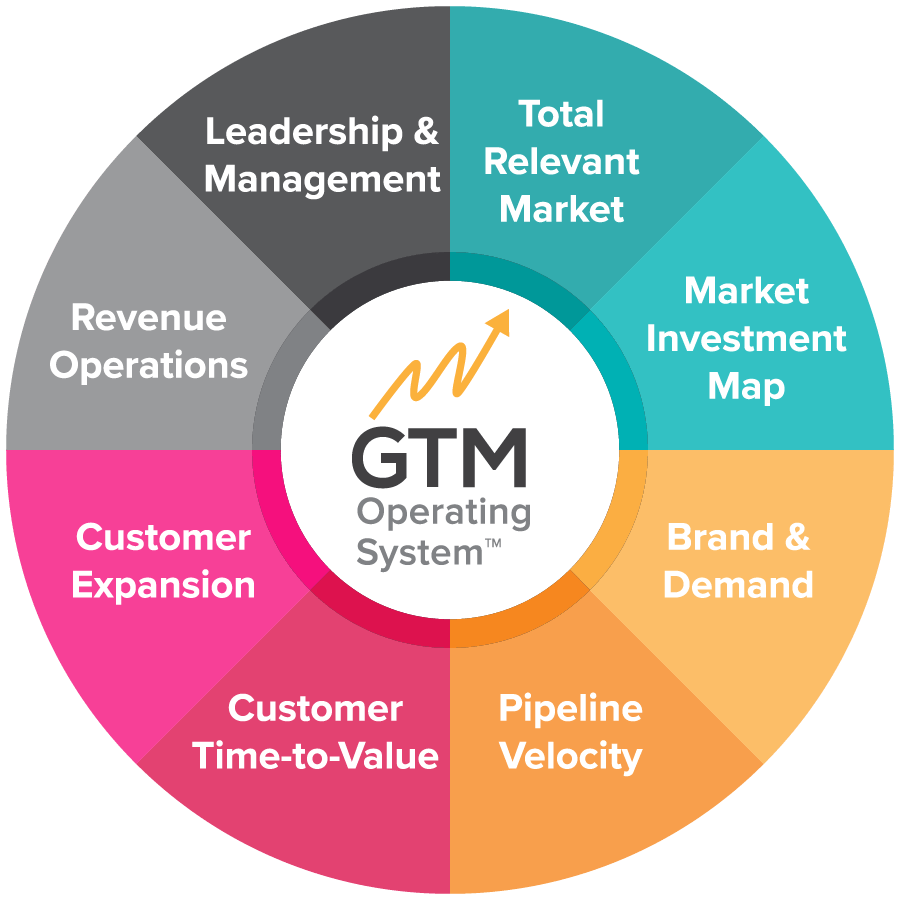 GTM OS™ Framework
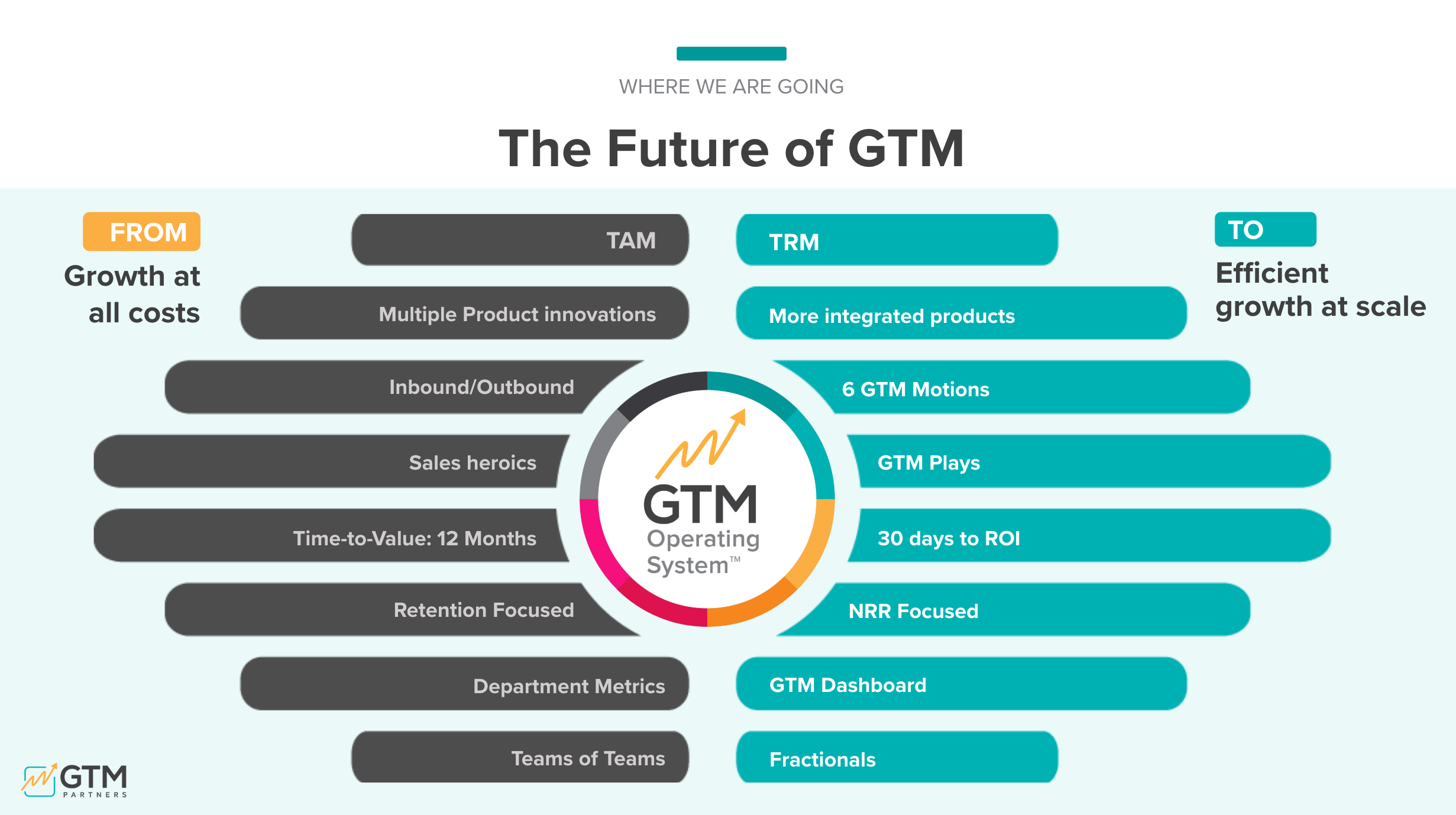
Most companies describe growth as a target: 3x pipeline, higher NRR, 30% revenue growth.
But a goal is not a strategy. And a strategy is not execution.
The companies that consistently hit their numbers have something underneath the targets: a repeatable system for deciding where to focus, how to grow, what to measure, and how the executive team operates together.
That system is GTM OS.
GTM OS Connects Strategy to Execution Across the Entire Business
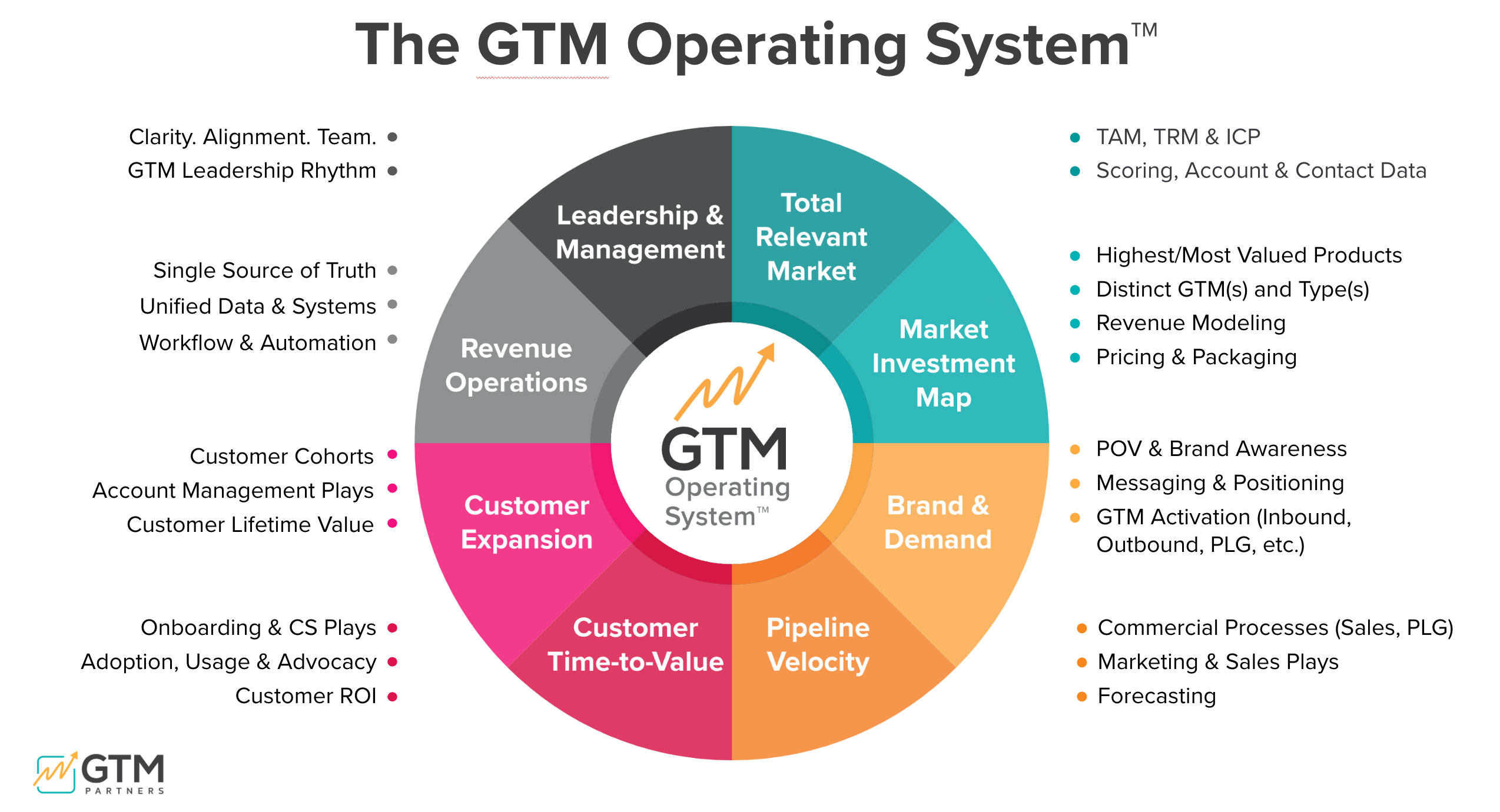
The GTM Operating System™ is an 8-pillar framework developed by GTM Partners that connects strategic planning to day-to-day execution.
It gives Product, Marketing, Sales, Customer Success, Revenue Operations, and Leadership one shared blueprint for how growth happens across the organization.
For the CEO and executive team, it also creates an objective diagnostic system for answering one of the most vital questions in business:
“Will our GTM strategy actually work — before the quarter tells us it didn’t?”
Every company has a go-to-market motion. Most companies do not have a go-to-market system.
Running on GTM OS is the difference between hoping the pieces fit together and knowing where they do — and where they don’t.
GTM Is Not a Department. GTM Is the Business.
GTM is not just a CRO problem. It is not just a marketing problem. It is not just a sales problem.
Go-to-market is how the company turns strategy into growth and revenue. That makes it a CEO-level operating system.
Five Executive Truths
1. GTM is a transformational process, not a one-time strategy.
GTM is not a launch, campaign, kickoff, annual plan, or reorganization. It is a continuous operating system that evolves as the business scales through each growth stage.
2. Transformation happens across teams, not inside functions.
You cannot fix Marketing and assume you fixed GTM. Growth breaks in the handoffs and dependencies between Product, Marketing, Sales, Customer Success, and RevOps.
3. Systems beat goals.
Ambitious targets without repeatable systems are how good strategies die in execution.
The question is not only: What number do we need to hit? It is: What system will make that number achievable?
4. NRR is one of the clearest signals of business health.
If a company cannot retain and expand customers, acquiring more of them will not solve the underlying problem. Net Revenue Retention reveals whether the GTM system is creating durable customer value or temporary growth.
5. GTM is the business — and the CEO owns it.
The CEO is the only leader with the scope and authority to align strategy, investment, priorities, tradeoffs, and operating cadence across the entire customer journey.
“Every company has a go-to-market motion. Most companies do not have a go-to-market system.”
— GTM Partners8 Questions Every Executive Team Needs to Answer
Each pillar of GTM OS answers one diagnostic question. If the executive team cannot answer one of these questions clearly, that is often where the system is breaking.
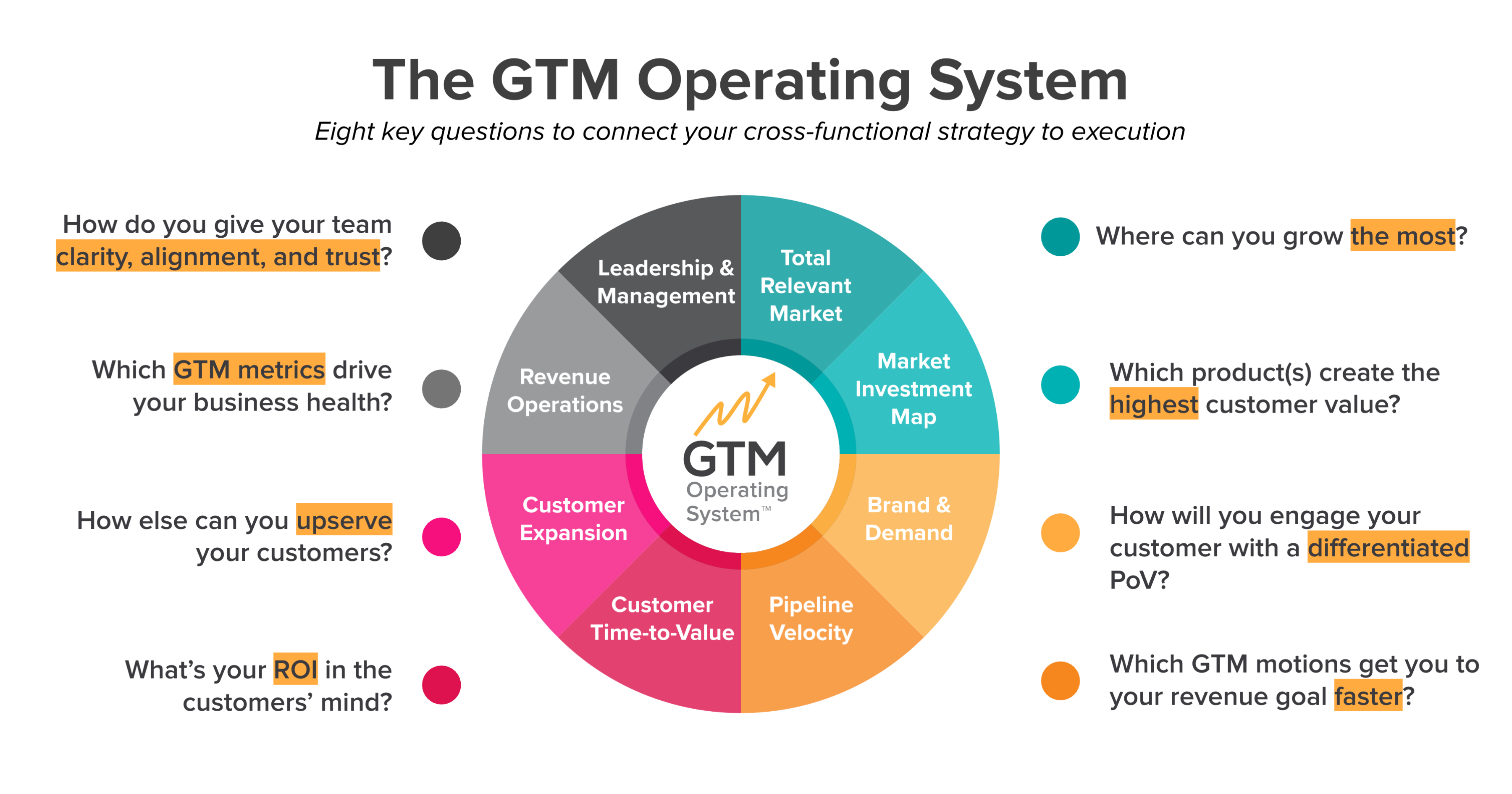
“Where can you grow the most?”
Define the customer segments, industries, and ideal customer profiles (ICPs) with the highest propensity to buy, renew, and expand.
“Which product(s) create the highest customer value?”
Decide where to allocate capital across products, markets, customer segments, and revenue expansion opportunities.
“How will you engage your customer with a differentiated PoV?”
Create category relevance and high-intent inbound demand by clearly articulating why the market should care and why your approach is different.
“Which GTM motions get you to your revenue goal faster?”
Determine which revenue motions (Inbound, Outbound, PLG, Ecosystem, Events) create the most efficient path from engagement to closed-won revenue.
“What’s your ROI in the customers’ mind?”
Accelerate the path from contract signing to measurable customer outcome and value realization to protect long-term retention.
“How else can you upserve your customers?”
Build a repeatable, proactive system for contract renewal, cross-sell, upsell, and advocacy to drive high Net Revenue Retention (NRR > 110%).
“Which GTM metrics drive your business health?”
Create one unified source of analytical truth across tech stack, data schemas, leading indicators, and operational handoffs.
“How do you give your team clarity, alignment, and trust?”
Build executive leadership rhythms, 90-day operating cadences, cross-functional accountability, and shared priorities to execute GTM as one business.
The pillars are intentionally sequenced: you begin with where to grow (TRM, MIM), decide how to grow (Brand & Demand, Pipeline Velocity), and then build the systems required to scale, retain, measure, and lead (Time to Value, Expansion, RevOps, Leadership).
However, GTM OS is also diagnostic. Companies do not always march mechanically from Pillar 1 to Pillar 8 — they begin where the system is breaking.
“The GTM Operating System is the most powerful model on the market, and I’d love nothing more than to see it become the go-to standard for all GTM leaders.”

What Does a Broken GTM System Look Like?
Without a shared operating system, companies tend to experience the same predictable failure patterns:
- •Strategy and execution operate in isolation.
- •Product, Marketing, Sales, Customer Success, and RevOps work in silos.
- •There is no shared definition of a good customer, a winning product, or the right GTM motion.
- •GTM risk becomes visible only after the quarter is missed.
- •Teams confuse frantic activity with actual progress.
- •Leadership reacts to symptoms instead of diagnosing root causes.
- •The company runs disconnected initiatives instead of one coordinated system.
That is why companies can have smart people, strong goals, sophisticated technology, and plenty of activity — and still miss the number.
The problem is not effort. The problem is system design.
A Good GTM Operating System Makes Growth Diagnosable
When GTM OS is in place, the executive team operates differently. The company can:
- ✓Validate strategic assumptions before committing capital.
- ✓Align functions around the same growth system.
- ✓Sequence investments intentionally instead of reactively.
- ✓Identify where breakdowns are happening and why.
- ✓Create a shared language across the executive team.
- ✓Connect strategy, metrics, ownership, and execution.
- ✓Make GTM performance visible before the quarter is over.
- ✓Focus the organization on fewer, higher-impact priorities.
“Running on GTM OS does not make growth easy. It makes growth diagnosable, repeatable, and accountable.”
How Companies Begin Running on GTM OS
Understanding the framework is only the beginning. Running on GTM OS requires turning decisions into a shared executive rhythm:
1. CEO Ownership
GTM transformation stalls without active executive sponsorship. The CEO does not need to personally execute every initiative, but they must own the system and the tradeoffs it requires.
2. Diagnose Before Redesigning
Do not start with a reorganization, new software tool, or new campaign. First determine your company’s current growth stage and identify the real constraint before changing org charts.
3. Align on the 8 Questions
Walk the executive team through the 8 diagnostic questions. The disagreements that surface are not distractions — they are the strategy conversation.
4. Start Where the System Is Breaking
Some companies need sharper market focus (TRM). Others need a stronger revenue motion, better customer value realization, or a disciplined 90-day operating plan. Focus on the constraint that matters most now.
5. Create One Source of Truth in Revenue Operations
A shared source of GTM data is essential. Without it, alignment is just a meeting. With it, alignment becomes a system.
6. Decide What Not to Do
Strategy is subtraction. The clarity of “no” is what gives “yes” its power.
There Are Two Good Ways to Start.
You do not need to implement all eight pillars at once.
The first job is to understand where the business is today, align the executive team around what is actually breaking, and decide what deserves focus next.
From there, companies typically begin in one of two ways.
Start With a 90-Minute GTM Transformation Workshop
Bring the executive team together with a Certified GTM OS Partner for a focused diagnostic conversation.
The goal is not to solve every GTM problem in 90 minutes. It is to create clarity around:
- •The company’s current business stage and GTM focus
- •Where leadership is aligned — and where it is not
- •Which GTM problems are symptoms versus root causes
- •Where the GTM system is most likely breaking
- •What the executive team should investigate or prioritize next
The discussion itself is valuable. Disagreement about the market, metrics, customers, priorities, or growth model often reveals the real strategy work that needs to happen.
Start With GTM Planning
GTM Planning is the flagship starting point for companies ready to put the GTM Operating System into practice.
Over a focused series of executive working sessions, the leadership team uses GTM OS to connect strategic decisions to a practical 90-day operating plan. The work typically includes:
- •Aligning on the company’s current business stage and GTM focus
- •Identifying the most important GTM problems to solve
- •Answering the eight GTM OS diagnostic questions
- •Completing the GTM OS on a Slide
- •Identifying which GTM OS pillars deserve deeper investment
- •Defining the revenue motions the company will prioritize
- •Translating those decisions into a focused 90-Day GTM Roadmap
The output is not another annual planning deck. It is a shared operating view of how the company intends to grow — and what the executive team will focus on over the next 90 days.
Then Go as Deep as the Business Requires
After GTM Planning, the company does not automatically launch eight projects. The executive team uses the diagnosis to determine what matters most.
That may mean:
- •Implementing one priority GTM OS pillar
- •Working through several interconnected pillars
- •Implementing the full GTM Operating System
- •Continuing with the existing system while changing only the areas creating the greatest constraint
A Certified GTM OS Partner can help your executive team implement any one — or all — of the eight GTM OS pillars, depending on the needs of the business.
GTM OS is deliberately sequenced, but it is also diagnostic and adaptive. The goal is not to “complete the framework.”
The goal is to improve how the business operates.
Running on GTM OS Is a Rhythm, Not a One-Time Project.
Once the system is in place, GTM OS becomes part of how the leadership team runs the business. Strategy is revisited on a regular cadence. Execution is measured against shared GTM metrics. Priorities are refreshed as the market, customer, and company change.
Align and Prioritize Execution
GTM teams align their work against the company’s active Revenue Model Playbook. The weekly rhythm keeps teams focused on the customers, motions, resources, and GTM priorities leadership has already agreed matter most.
The purpose is not another status meeting. It is to make sure execution continues to reflect strategy.
Measure Whether Execution Is Working
Leadership and RevOps track the impact of GTM execution against the GTM Executive Scorecard. RevOps provides the shared source of truth so the executive team can see whether the agreed GTM strategy is producing the expected leading indicators and business outcomes.
This allows the company to identify risk before a missed quarter makes the problem obvious.
Revisit Strategy and Reset the Next 90 Days
At the beginning of each 90-day cycle, leadership runs the GTM Planning process again. The executive team revisits the GTM OS on a Slide, tests the assumptions behind the current GTM strategy, and determines what has changed.
Reassessing:
- • Current business stage and GTM focus
- • Priority customers and markets
- • Products and investments
- • Revenue motions
- • GTM health and performance
- • Pillars requiring attention
- • What the company should stop doing
Concluding with:
- ✓ An updated GTM OS on a Slide
- ✓ An updated Revenue Model Playbook
- ✓ A fresh set of 90-day GTM priorities
- ✓ Clear owners, metrics, and execution expectations
“Running on GTM OS means strategy and execution are never allowed to drift too far apart.”
GTM Is the Business. And the CEO Owns It.
The operating rhythm is what turns GTM OS from a framework into an operating system.
The framework creates shared language. GTM Planning creates alignment and priorities. The Revenue Model Playbook guides execution. The GTM Executive Scorecard measures impact. And the 90-day cadence forces the leadership team to continuously reconnect strategy to what is actually happening in the business.
That is what it means to run on GTM OS.
GTM OS represents a broader shift in how companies operate: from disconnected goals to shared systems, from functional silos to executive alignment, and from reactive planning to repeatable operating rhythms.
Running on GTM OS turns ambition into a system that can actually deliver — quarter after quarter, stage after stage.
The companies that scale do not simply have better goals. They have a better operating system.
What CEOs and Operators Say About the GTM Operating System™
Perspectives from leadership teams using GTM OS to create alignment, connect strategy to execution, and build a more repeatable path to growth.
"Before the GTM OS, our growth strategy was fragmented—we had all the pieces but no unified view. It provided the essential framework that finally tied everything together, driving true executive alignment and a clear, repeatable path to scale."
"The GTM Operating System provides an invaluable, unifying foundation that solidifies and optimizes our product-to-market strategy for maximum executive confidence."
"It's a fantastic, comprehensive framework that, despite any current operational pressures, is a worthwhile investment of executive time for long-term strategic benefit."
Ready to Put GTM OS to Work in Your Business?
Describe what is happening in your business and we’ll match you with a Certified GTM OS Partner trained to help executive teams diagnose, align, and implement the system.