
The 5 Types of ROIProving Multi-Dimensional Value Across Complex Buying Committees
Traditional single-variable ROI calculators fail because CFOs don’t believe them and buying committees evaluate different outcomes. The 5 Types of ROI matches the proof to what each executive actually cares about.
 Framework Library
Why Traditional ROI Calculators Fail to Close Deals
For decades, B2B vendors have relied on simplistic ROI calculators that attempt to force every software platform, service, and solution into a single equation: (Net Financial Gain ÷ Cost) × 100.
In today’s market, this approach collapses under scrutiny. CFOs and finance committees routinely reject generic 500% ROI claims because direct revenue attribution is messy, multi-touch, and shared across dozens of tools. Furthermore, buying committees are composed of 6 to 10 distinct stakeholders—a Security Director cares about risk mitigation, an Operations Lead cares about workflow efficiency, and a CEO cares about strategic market positioning.
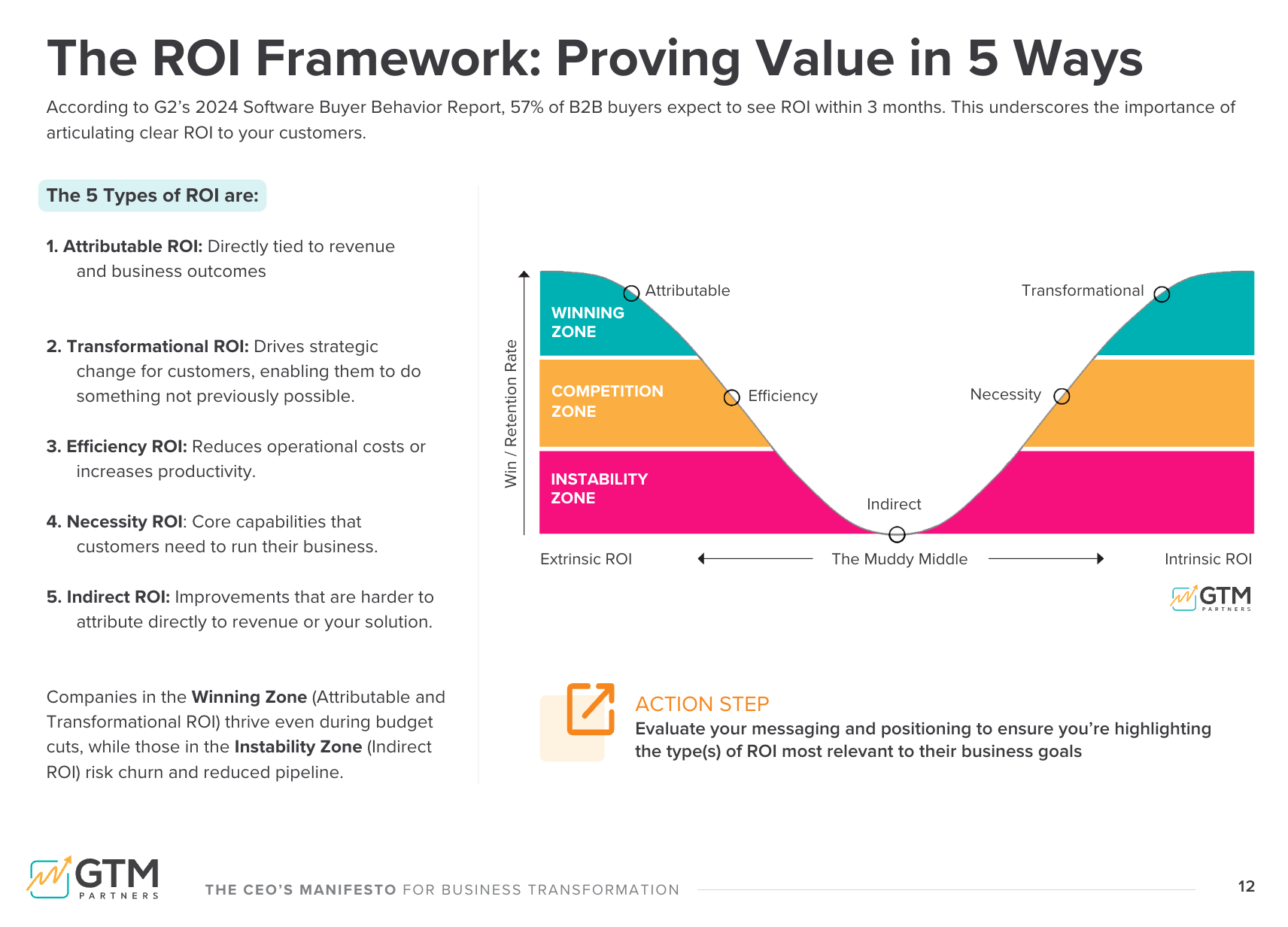
The Winning Zone: Companies that can show Attributable and Transformative ROI are at an almost insurmountable advantage. Since they are either transforming how customers do business or they can prove directly attributable ROI, they’re not getting cut. Companies in the winning zone can out-maneuver competitors through big strategic moves and investments.
The Competition Zone: Vendors in the Efficiency and Necessity zones can be very successful and may even be category leaders. However, they’re constantly defending against other players who can easily force competition on features, ease of use, price, and efficiency gains.
The Instability Zone: Vendors who can only show Indirect ROI are in what we call the muddy middle, where retention gets hammered. In a down economy, CFOs will not approve new or renewed tech that can’t show ROI. Companies showing Indirect ROI get lumped with dozens of other providers as one of many contributors to some final outcome.
Your goal is to move up the slope, from the muddy middle through the Competition Zone, and hopefully eventually to the Winning Zone.
Intrinsic ROI: You provide inherent value without need for quantitative measurement. You’re valuable because you are taking action or moving in the right direction.
Extrinsic ROI: Valuable to the degree it creates measurable outcomes where the results speak for themselves.
Operationalizing ROI Across the Customer Lifecycle
ROI is not a sales slide presented once during closing; it is the Value Bridge that connects pre-sale promises to post-sale onboarding and long-term contract renewal.

1. Pre-Sale Value Mapping
Sales reps map customer pain points directly to 1–2 dominant ROI dimensions during discovery, establishing mutual close criteria with the economic buyer.
2. 30-to-90 Day Time-to-Value
The agreed ROI criteria are handed directly to Customer Success as onboarding milestones, ensuring first measurable value is realized within 90 days.
3. Continuous Renewal Defense
Quarterly Business Reviews present documented Efficiency, Necessity, and Attributable ROI proof points, neutralizing renewal budget cuts before negotiations begin.
Download The GTM ROI Framework Playbook
Get the complete executive guide with templates for calculating Attributable, Operational, Transformational, Strategic, and Necessary ROI.