GTM Partners
Get Started
HomeAnswersThe 5 Types of ROI Framework
All GTM Answers
Financial Metrics, Retention & Valuation

The 5 Types of ROI Framework

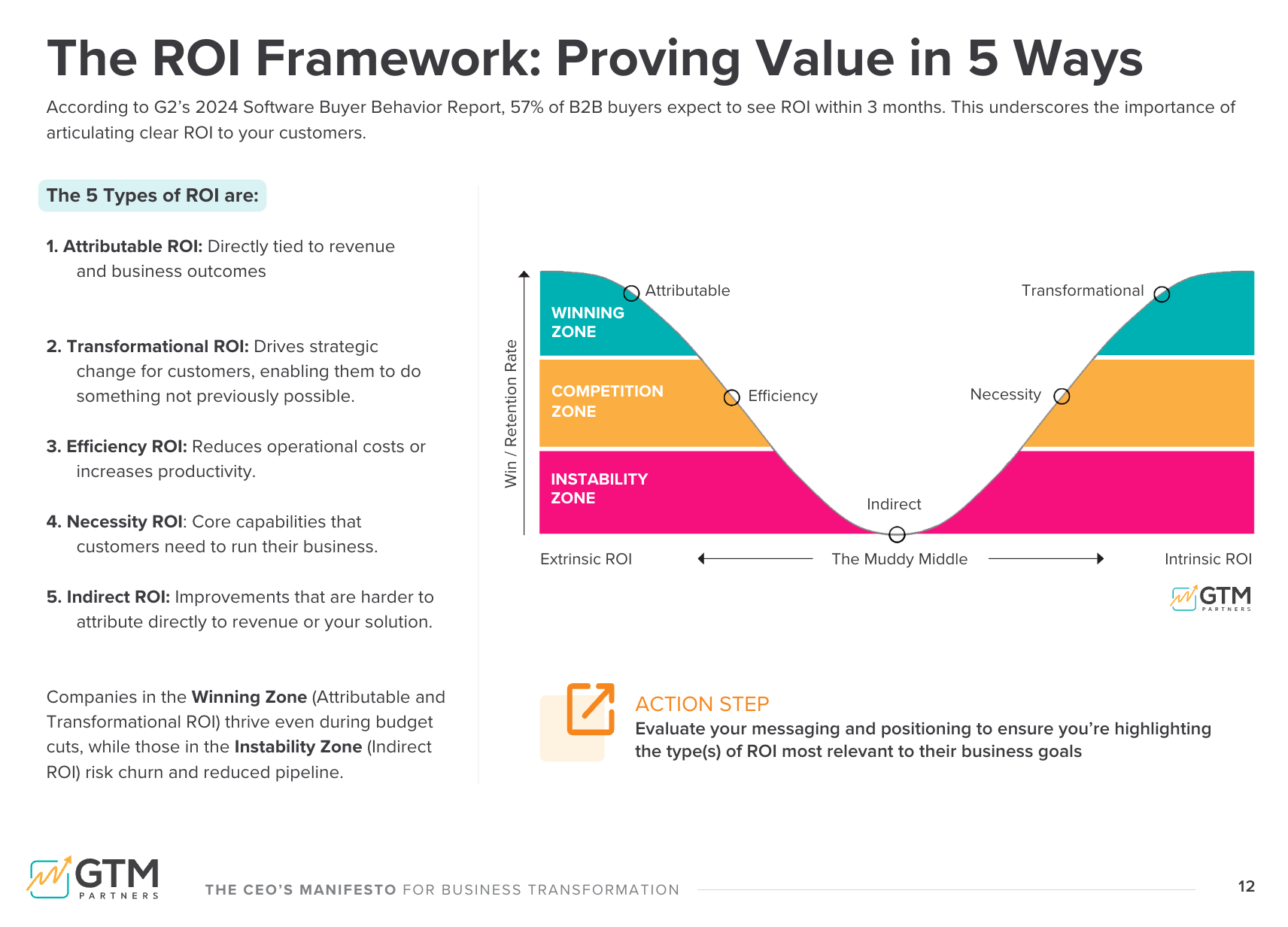
In today’s efficient growth environment, B2B buyers no longer purchase software based on vague promises or feature checklists—they buy because an executive business case proves clear, multi-dimensional return on investment. GTM Partners’ **5 Types of ROI Framework** codifies how category leaders articulate and prove business value across all five dimensions: **Attributable ROI, Transformational ROI, Efficiency ROI, Necessity ROI, and Indirect ROI.** Aligning your sales messaging, customer success onboarding, and customer time-to-value around these five value dimensions moves your solution out of the "muddy middle" and into the Winning Zone.

The ROI Framework: Proving Value in 5 Ways by GTM Partners
Figure: The GTM ROI Framework & Win-Rate U-Curve (The CEO Manifesto)

By GTM Partners

Frequently Asked Executive Questions

Click question to expand

Prospects may be interested in your product but unable to justify purchasing it due to a misalignment in how ROI is communicated and perceived across different buyer personas. The GTM Partners' "5 Types of ROI" framework highlights that ROI is not a one-size-fits-all metric. While CFOs and CEOs often seek direct financial justification, other stakeholders like managers and end-users may prioritize operational efficiency, ease of use, or strategic transformation. Your challenge is to identify and articulate the specific type of ROI your product delivers and ensure that this aligns with the needs and expectations of each persona involved in the buying decision.

To address this, leverage the framework to diagnose which ROI story is most credible and relevant for each persona. This means moving beyond traditional financial metrics to include transformational, operational, or necessity-based ROI where applicable. By aligning your value proposition with the diverse expectations of the buyer committee, you can enhance your pipeline predictability, improve win rates, and shorten sales cycles.

GTM OS Canonical FrameworkThe 5 Types of ROI Framework
Supporting Research & Deep DiveHow to Match ROI to Your Buyer's Needs

To build an ROI case that a CFO will believe, leverage the 5 Types of ROI framework from GTM Partners. This approach expands beyond traditional ROI calculations, recognizing that different stakeholders require different proofs of value. For a CFO, focus on demonstrating financial justification through Efficiency, Necessity, Transformational, or Attributable ROI. This involves clearly showing how your solution will generate revenue, save costs, or provide a defensible economic benefit.

Start by identifying the strongest and most credible ROI story for your solution, supported by third-party validation such as case studies or G2 reviews. This external validation is crucial for overcoming skepticism and making your ROI claims more credible. Equip your champions with this validated ROI narrative, ensuring they can effectively communicate the value to the buying committee. By aligning your ROI story with the CFO's priorities and providing credible evidence, you increase the likelihood of securing buy-in and investment.

GTM OS Canonical FrameworkThe 5 Types of ROI Framework
Supporting Research & Deep DiveHow to Match ROI to Your Buyer's Needs

B2B buyers value more than just cost savings; they seek comprehensive ROI that aligns with their strategic objectives and operational needs. According to GTM Partners' 5 Types of ROI framework, value can be transformational, operational, strategic, necessary, or indirectly tied to business outcomes. For instance, economic buyers like CFOs prioritize financial justification, focusing on revenue generation and cost efficiency. However, end users and managers might prioritize solutions that simplify workflows, enhance productivity, or facilitate skill development. Champions within the organization are often concerned with achieving objectives on time and within budget, as well as demonstrating success internally. Therefore, to effectively engage B2B buyers, companies must tailor their ROI narrative to address these diverse needs, ensuring that each stakeholder sees the solution's value in terms of their specific priorities and challenges. This approach not only aids in closing deals but also in retaining customers and expanding accounts.

GTM OS Canonical FrameworkThe 5 Types of ROI Framework
Supporting Research & Deep DiveYour 2025 ROI Playbook

You're getting pushed into feature comparisons and discounting because your current ROI narrative isn't resonating with your buyers. This often happens when companies are stuck in the "muddy middle" of ROI storytelling, where the value proposition is neither clear nor compelling enough to differentiate from competitors. According to GTM Partners' 5 Types of ROI framework, it's crucial to diagnose and articulate the specific type of value your solution provides—whether it's transformational, operational, strategic, necessary, or directly attributable to financial outcomes.

To escape the feature and price trap, align your ROI story with the needs of each buyer persona. For instance, CFOs may require proof of financial justification, while end users might need evidence of improved efficiency or reduced workload. By credibly demonstrating the unique value your solution delivers, you can enhance your win rates, reduce sales cycles, and protect your pricing power, ultimately leading to a more predictable pipeline and higher gross revenue retention.

GTM OS Canonical FrameworkThe 5 Types of ROI Framework
Supporting Research & Deep DiveHow to Match ROI to Your Buyer's Needs

Sales and customer success teams should leverage the same customer value story by aligning around the 5 Types of ROI framework. This ensures a unified narrative that resonates with different buyer personas and stakeholders, from CFOs to end-users. By diagnosing and articulating the specific type of ROI—be it Efficiency, Necessity, Transformational, or Attributable—both teams can present a cohesive and credible proof of value that accelerates deal closure, enhances customer retention, and supports account expansion. This alignment is crucial for maintaining a predictable pipeline, improving win rates, and achieving a Gross Revenue Retention (GRR) above 90%. In tight economic conditions, where budget scrutiny is high, a unified ROI story not only differentiates your offering but also solidifies its indispensability, ensuring that customers see the tangible benefits of staying and expanding with your solution.

GTM OS Canonical FrameworkThe 5 Types of ROI Framework
Supporting Research & Deep DiveYour 2025 ROI Playbook

To prove value before renewal, leverage the 5 Types of ROI framework to align your value demonstration with the specific needs of each stakeholder involved in the renewal decision. Begin by identifying which type of ROI—Attributable, Transformational, Efficiency, Necessity, or Indirect—your solution most credibly delivers. Tailor your value proof to resonate with each persona: CFOs and CEOs typically require concrete financial justification, such as Attributable ROI, while champions and users may need evidence of operational improvements or strategic enablement.

Ensure your GTM teams are equipped to articulate this value across sales, customer success, and marketing functions. This alignment not only strengthens your renewal case but also positions your company to protect against retention pressures and expansion challenges. By broadening the ROI conversation beyond traditional financial metrics, you can credibly demonstrate the comprehensive value your solution provides, thereby securing renewals and fostering long-term customer relationships.

GTM OS Canonical FrameworkThe 5 Types of ROI Framework
Supporting Research & Deep DiveHow to Match ROI to Your Buyer's Needs

When a customer says, "We can’t quantify the ROI," it's crucial to leverage the 5 Types of ROI framework to expand the conversation beyond traditional financial metrics. Start by diagnosing which type of ROI your solution provides: Attributable, Transformational, Efficiency, Necessity, or Indirect. Identify the strongest and most credible ROI story for your product and tailor it to the specific needs of each buyer persona involved in the decision-making process. For instance, CFOs may require clear financial justification, while operational managers might need evidence of improved efficiency or strategic value.

Ensure your GTM teams are equipped to articulate these diverse ROI stories credibly, aligning them with the buyer's objectives and pain points. This approach not only helps in closing deals but also in retaining and expanding customer accounts, ultimately leading to a more predictable pipeline, higher win rates, and improved customer retention (GRR > 90%). By broadening the value conversation, you mitigate the risk of stalled pipelines and enhance your competitive positioning.

GTM OS Canonical FrameworkThe 5 Types of ROI Framework
Supporting Research & Deep DiveHow to Match ROI to Your Buyer's Needs
Explore All GTM Answers & Topics