To determine if you're targeting the right market, focus on your Total Relevant Market (TRM) rather than the broader Total Addressable Market (TAM). TRM is about identifying the segments where your current offerings, capabilities, and resources align perfectly with the needs of the market today. This approach ensures you're not just chasing the largest possible market but are strategically targeting those who will derive the most value from your solutions right now. By honing in on your TRM, you can optimize your go-to-market efforts, leading to improved pipeline predictability, higher win rates, and enhanced customer retention (GRR > 90%). This focus allows you to build a more efficient and effective GTM strategy, driving sustainable growth and better unit economics. Remember, success lies in being indispensable to a defined segment, not in being everything to everyone.
Total Relevant Market (TRM) & ICP
Total Relevant Market (TRM) is Pillar 1 of the GTM Operating System™: GTM Partners’ proprietary methodology replacing broad, inflated Total Available Market (TAM) estimates with actionable market focus. While TAM encompasses every theoretical buyer who could ever purchase your product, TRM rigorously isolates the **Tier-1 Ideal Customer Profile (ICP) accounts with the highest propensity to buy, onboard rapidly, renew consistently, and expand profitably.** Anchoring your revenue engine to TRM eliminates wasted acquisition spend, accelerates sales cycles, and concentrates resources where win rates and lifetime values are highest.
By GTM Partners
Frequently Asked Executive Questions
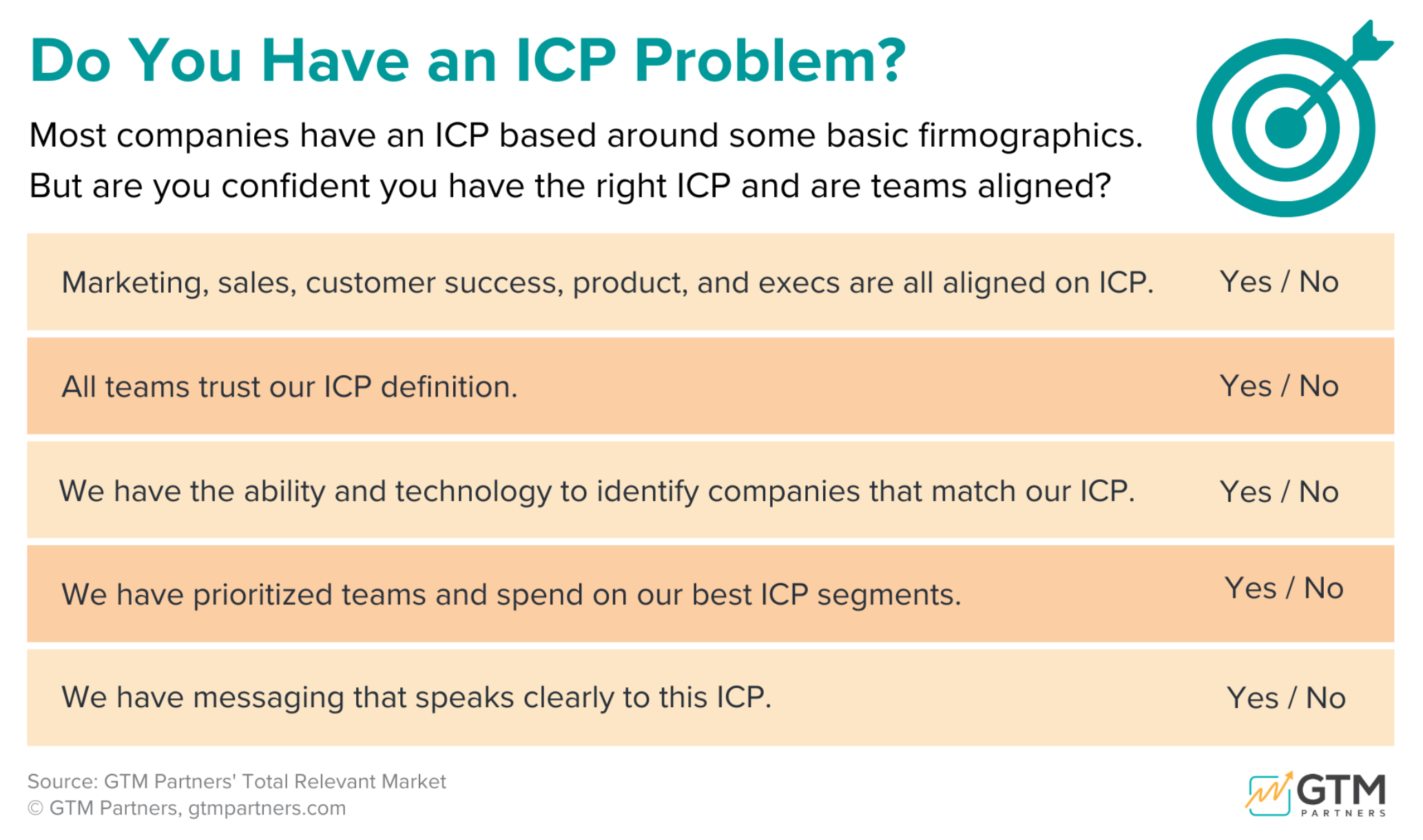
Click question to expandYour ICP is probably too broad if it relies mainly on basic firmographics—such as company size, industry, geography, or revenue—and still describes a large group of companies that behave very differently as customers. Firmographics are useful starting points, but they do not explain who is most likely to buy, succeed with your solution, renew, and expand.
A strong ICP is a model of the characteristics that predict a durable customer relationship. It considers the operational realities, buying conditions, capability gaps, and other patterns shared by your best customers—not just their industry or employee count. If sales is pursuing accounts that look qualified on paper but rarely close, marketing messaging feels too generic, or retention and expansion vary widely across your target accounts, your ICP likely needs more definition.
Start by defining what your best customers have in common: the characteristics that predict they will buy, realize value, renew, and expand. If those patterns differ meaningfully by customer type, build a distinct ICP model for each. Together, those prioritized ICP segments make up your Total Relevant Market (TRM)—the market your company should focus on today. The goal is not to make the market artificially small, but to direct GTM resources toward customers most likely to create durable growth.
Your struggle to close and retain customers likely stems from a misalignment between your lead generation efforts and your Total Relevant Market (TRM). While you may be generating leads, they might not align with your Ideal Customer Profile (ICP) within your TRM. This misalignment can lead to lower win rates and customer retention issues, as you may be attracting prospects who are not the best fit for your current offerings and capabilities.
To address this, focus on refining your ICP to ensure it accurately reflects the segments that will derive the most value from your products today. This involves a deep dive into your TRM to identify and prioritize the segments that are not only relevant but also actively in market (AIM) for your solutions. By aligning your go-to-market efforts with your TRM, you can improve pipeline velocity, increase win rates, and enhance customer retention, ultimately driving more predictable and sustainable growth.
To define an Ideal Customer Profile (ICP) that aligns with who will actually buy, renew, and expand, leverage the Total Relevant Market (TRM) framework. Start by identifying segments where your product's value proposition resonates most strongly today, not aspirationally. These segments should be defined by characteristics that predict successful engagement, such as organizational structure, operational patterns, and workforce composition. This ensures your ICP is grounded in reality, focusing on buyers who are ready to engage and benefit from your offerings immediately.
Once these segments are identified, sum them to determine your TRM, which is dynamic and should be revisited as market conditions and your offerings evolve. This approach not only narrows your focus to the most promising buyers but also aligns your entire go-to-market strategy—from marketing to sales and customer success—ensuring efficient pipeline generation, higher win rates, and improved customer retention. By targeting the right ICP, you enhance Gross Revenue Retention (GRR) and set the stage for predictable growth and expansion.
A large TAM can often mask a focus problem by creating the illusion of endless opportunities, which can lead to diluted efforts and inefficiencies. The key is to shift from a broad TAM perspective to a more strategic Total Relevant Market (TRM) approach. TRM forces you to concentrate on the segments where your product or service delivers the most value today, aligning your go-to-market efforts with your current capabilities and resources. This focus enhances predictable pipeline generation, improves win rates, and shortens sales cycles by targeting buyers who are most likely to appreciate and benefit from your offerings immediately. By narrowing your focus to a well-defined Ideal Customer Profile (ICP), you can optimize your unit economics and drive Gross Revenue Retention (GRR) above 90%, ensuring sustainable growth and market penetration.
To prioritize customer segments effectively, focus on your Total Relevant Market (TRM) as outlined in GTM Partners' frameworks. TRM narrows down your focus to the most relevant buyers based on your current offerings, value proposition, and resources. Begin by identifying segments that align with your Ideal Customer Profile (ICP) and are likely to appreciate your value today. This approach ensures you're targeting segments that can drive predictable pipeline growth, improve win rates, and optimize sales cycles.
Consider segments that not only fit your ICP but are also "Already In Market" (AIM) — those actively seeking solutions like yours. These segments should be prioritized as they are most likely to convert quickly, enhancing your pipeline velocity and contributing to Gross Revenue Retention (GRR) above 90%. By aligning your go-to-market efforts with these segments, you ensure efficient resource allocation and maximize your growth potential within the next 12 to 18 months.
To decide which accounts are not worth pursuing, leverage the Total Relevant Market (TRM) framework to focus on accounts that align with your Ideal Customer Profile (ICP) and are likely to deliver predictable pipeline and efficient growth. Begin by identifying the segments within your TRM that are most aligned with your current offerings and strategic goals. Evaluate accounts based on qualifying characteristics such as organizational structure, operational patterns, workforce composition, and capability gaps that indicate a strong need for your solution.
Exclude accounts that fall outside these parameters, as they are less likely to convert efficiently or contribute to Gross Revenue Retention (GRR > 90%). Additionally, overlay intent data to prioritize accounts actively in the market, ensuring your resources are concentrated on high-probability opportunities. This strategic focus not only optimizes your sales cycles and win rates but also enhances unit economics by reducing wasted effort on low-fit prospects.