Making Growth Repeatable: Scaling Beyond One Motion
Turn early traction into a coordinated, predictable GTM system. GTM OS helps Series A and B leaders validate Product-Market Fit, sharpen the ICP, improve pipeline efficiency, align revenue motions, and establish a disciplined 90-day operating cadence.
“At the growth stage, scale is not about adding more resources. It is about proving that every added dollar of capacity produces more predictable, efficient revenue.”
 Use Cases Hub
When Scaling Capacity Outpaces Sales Efficiency
As companies move from early traction into Series A and B, the commercial challenge changes. Adding sales reps, increasing ad spend, and opening new channels no longer guarantees growth—and often exposes weaknesses that early founder-led selling could hide.
Growth breaks when the company adds capacity before proving repeatability across the market, product, pipeline, and customer journey.
Sales Capacity Scales Before Sales Efficiency
The company adds reps before proving that the ICP, qualification model, conversion rates, and sales cycle are repeatable. More capacity then amplifies inefficiency instead of growth.
The Business Enters Valleys of Death 2 & 3
Early founder traction gives way to operational complexity. The company must prove that Product-Market Fit is repeatable across customers before expanding into more segments, products, teams, or motions.
Sales and Marketing Are Misaligned on the ICP
Marketing generates accounts Sales does not want, while Sales pursues one-off opportunities that require custom work and churn prematurely. Without a shared ICP, commercial spend becomes fragmented.
Pipeline Volume Masks Pipeline Quality
Top-of-funnel activity creates false confidence when conversion, qualification, deal velocity, and retention are weakening underneath it.
Forecasting Is Still Based on Judgment More Than Math
Inconsistent deal velocity, stage definitions, and conversion assumptions force leadership to guess at future revenue instead of managing against reliable leading indicators.
Functional Silos Slow the Customer Journey
Product, Marketing, Sales, and Customer Success optimize their own parts of the funnel, creating handoff friction, slower time-to-value, and weaker retention.
At the growth stage, scaling is not an activity game—it is an alignment game. Sustainable scale is achieved when every added dollar of capacity produces predictable, efficient revenue throughput.
How GTM OS™ Is Applied to Series A & B Companies
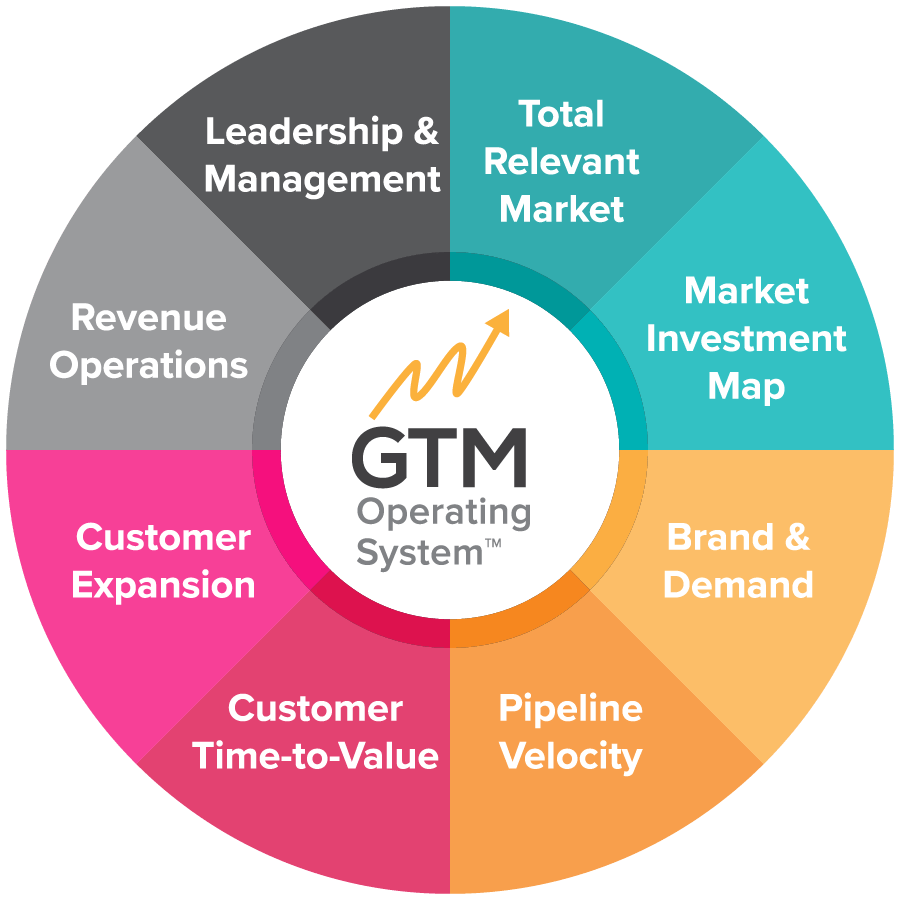
Validate Product-Market Fit and Stage Transition
Validate that Product-Market Fit is repeatable across a defined customer cohort before investing heavily in sales capacity, new products, or additional GTM motions.
Do we have evidence that the product creates repeatable, compounding value for a clearly defined customer profile?
Sharpen the ICP Through Total Relevant Market
Move from a broad ICP to a tiered view of the market based on win rate, retention, expansion potential, margin, and buying behavior.
The objective is not more addressable accounts. It is greater commercial concentration around the accounts most likely to create durable value.
Are Sales, Marketing, Product, and Customer Success aligned around the same high-value customer tiers?
Optimize Pipeline Velocity & Stage Conversion Metrics
Diagnose where deals stall and improve the four metrics that determine commercial throughput: qualified pipeline volume, ACV, win rate, and sales-cycle length.
Which pipeline stages create the most friction—and what must change to improve conversion or cycle time?
Implement a 90-Day GTM Planning Cadence
Turn strategy into a disciplined quarterly operating rhythm. Leadership selects the three to four highest-leverage GTM priorities, assigns clear owners, tracks leading indicators, and adjusts before problems become missed quarters.
Which three to four GTM priorities must we execute this quarter to make the revenue engine more predictable?
What Changes When Growth Becomes Repeatable
Higher Quota Attainment Without Blindly Adding Headcount
A more repeatable ICP, qualification model, and sales process allow incoming reps to reach productivity with greater consistency.
More Predictable Revenue Forecasting
Consistent conversion, stage definitions, and pipeline math give leadership earlier visibility into where the quarter is heading.
One Cross-Functional Definition of the Customer
Marketing, Sales, Product, and Customer Success align around the same ICP, buying signals, customer value, and expansion potential.
More Efficient CAC and Commercial Spend
Greater market focus reduces wasted acquisition spend, shortens sales cycles, and concentrates resources on customers with stronger economics.
A Stronger Foundation for the Next Stage of Scale
The company builds the operating discipline required to add products, markets, motions, and people without recreating the chaos of the early stage.
Key Focus
Making Growth Repeatable & Scaling with Discipline
How growth-stage executive teams use GTM OS to transition from early traction to predictable multi-motion throughput.
"Before TRM, we were still letting old habits drive where sales spent time—even when Salesforce made it obvious we were working bad-fit deals. This ICP work was meant to stop that, and it requires operationalizing the TRM rules with data so teams actually follow them."
"We’ve stopped guessing. I now evaluate every decision through one powerful lens: 'What drives the most impact for our customers and growth?' The GTM OS is the catalyst for making those high-impact, value-first choices."
"Partner with the sharpest minds in Go-to-Market to leverage an extensive, outstanding system that delivers a competitive, executive-vetted advantage."
Make the Revenue Engine Repeatable Before You Add More Capacity
A Certified GTM OS Partner can help your executive team validate repeatability, sharpen the ICP, improve pipeline velocity, and establish a 90-day operating cadence before the company commits more headcount and capital.