GTM Partners
Get Started
HomeAnswersThe 5 Valleys of Death & Scaling Traps
All GTM Answers
Diagnosis, Leadership & Operating Model

The 5 Valleys of Death & Scaling Traps

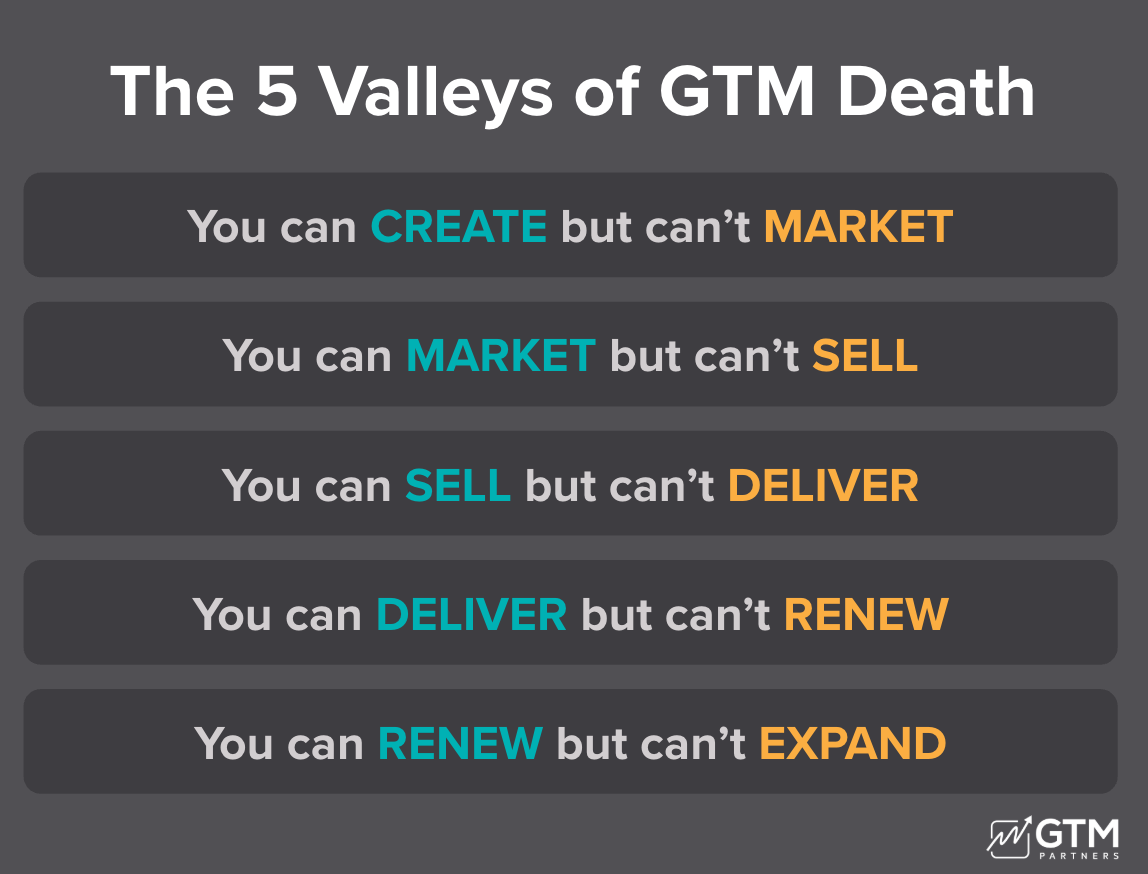
The 5 Valleys of Death identify the predictable transition points where companies stall as they move from creating demand to converting, delivering, renewing, and expanding.

The 5 Valleys of GTM Death Concise Framework by GTM Partners
Figure: The 5 Valleys of GTM Death (CREATE, MARKET, SELL, DELIVER, RENEW, EXPAND)

By GTM Partners

Frequently Asked Executive Questions

Click question to expand

Growth stalling despite having a good product often indicates you are navigating one or more of the 5 Valleys of Death within your GTM system. These Valleys highlight systemic issues, not departmental ones, where your growth is breaking down. For instance, you might be able to create but can't market effectively, meaning the market doesn't yet understand or want your product at scale. Alternatively, you might market well but struggle to convert that demand into sales, indicating inefficiencies in your sales process.

To diagnose the root cause, assess where your GTM system is failing to produce efficient, repeatable growth. Are you relying on heroic sales efforts rather than scalable plays? Is there misalignment between sales, marketing, and customer success? Use the 5 Valleys as a diagnostic tool to realign your GTM strategy, ensuring each function supports predictable pipeline, improved win rates, and enhanced customer retention (GRR > 90%).

GTM OS Canonical FrameworkThe 5 Valleys of Death Framework

B2B companies often stop growing due to systemic issues identified in the "5 Valleys of Death" framework. These valleys represent critical points where growth stalls: inability to market a created product, failure to convert marketing efforts into sales, challenges in delivering on sales promises, difficulty in renewing customer contracts, and lack of expansion opportunities post-renewal. Each valley highlights a breakdown in the go-to-market (GTM) system rather than isolated departmental failures. For instance, you might have a strong product but struggle to generate demand or convert that demand into revenue, leading to poor win rates and unpredictable sales cycles.

Additionally, growth can be hindered by broader GTM problems, such as reliance on heroic sales efforts rather than scalable processes, misalignment between sales, marketing, and customer success, and an inability to forecast revenue accurately.

GTM OS Canonical FrameworkThe 5 Valleys of Death Framework

Your challenge of winning customers but not retaining them likely stems from the fourth Valley of Death: "You can DELIVER but can’t RENEW." This indicates that while your product is being used, customers are not perceiving sufficient ROI to justify renewal. The root issue often lies in the inability to clearly demonstrate the value and impact of your product on the customer's business outcomes. This is not a failure of any single department but a systemic GTM issue that requires realignment.

To address this, focus on enhancing your value communication strategy. Ensure that your customer success and account management teams are equipped to quantify and communicate the tangible benefits and ROI of your product throughout the customer lifecycle. This will improve Gross Revenue Retention (GRR > 90%) and ensure predictable, repeatable growth.

GTM OS Canonical FrameworkThe 5 Valleys of Death Framework

As your company scales, sales and marketing often become less effective due to systemic issues identified in GTM Partners' "5 Valleys of Death." These valleys highlight where growth stalls: from creating demand but failing to market effectively, to generating interest but struggling to close sales, and delivering on promises but failing to renew or expand customer relationships. These are not isolated departmental issues but systemic GTM problems that require strategic realignment.

The root cause often lies in a misalignment of your GTM system, where sales, marketing, and customer success are out of sync, leading to inefficiencies in pipeline generation, win rates, and customer retention. To address this, diagnose which valley your company is in and realign your GTM strategy to ensure predictable, repeatable growth.

GTM OS Canonical FrameworkThe 5 Valleys of Death Framework
Supporting Research & Deep DiveThe CEO's Manifesto for GTM

Scaling too early often manifests as entering one or more of the 5 Valleys of Death, where growth stalls due to systemic GTM issues. To determine if you're scaling prematurely, assess whether your GTM system is producing efficient, repeatable growth or if you're encountering breakdowns in key areas. For instance, if you can create but can't market effectively, or if you can sell but can't deliver, these are indicators that your foundational GTM processes aren't mature enough to support scaling.

Additionally, if you're relying on heroic sales efforts rather than predictable plays, or if your sales, marketing, and customer success teams are out of sync, these are red flags of premature scaling. Evaluate your ability to predict revenue, maintain high gross revenue retention (GRR > 90%), and ensure alignment across your GTM functions before committing to scale.

GTM OS Canonical FrameworkThe 5 Valleys of Death Framework

Yes, a company can indeed fall back into a growth stall it has previously resolved. The 5 Valleys of Death framework highlights that these challenges are not linear or one-time hurdles; they are systemic issues within the GTM system that can recur if not continuously managed. A company might have successfully navigated a particular valley, such as converting demand into sales, but if the underlying GTM system weaknesses are not addressed, it can slip back into the same or a different valley.

For example, if the alignment between sales, marketing, and customer success is not maintained, or if the company fails to adapt its strategy to market changes, it can find itself struggling with the same issues again. The key is to use the Valleys as a diagnostic tool to continuously monitor and realign the GTM system to ensure efficient, repeatable growth.

GTM OS Canonical FrameworkThe 5 Valleys of Death Framework

Early warning signs that your GTM model is breaking can be identified through the lens of the 5 Valleys of Death. These Valleys represent critical junctures where growth stalls due to systemic GTM issues, not isolated departmental failures. For instance, if you can create but can't market, it indicates a failure to generate demand for a valuable product. If you can market but can't sell, it suggests inefficiencies in converting demand into revenue, often reflected in poor win rates or reliance on a few heroic sales performers. Additionally, if you can deliver but can't renew, it highlights a lack of perceived ROI among customers, threatening retention and Gross Revenue Retention (GRR > 90%). Monitoring these Valleys helps diagnose where growth is breaking down, allowing for strategic realignment to ensure efficient, repeatable growth.

GTM OS Canonical FrameworkThe 5 Valleys of Death Framework
Explore All GTM Answers & Topics