GTM Partners
Get Started
HomeAnswersThe 6 Core GTM Revenue Motions
All GTM Answers
Market Focus, ICP & Revenue Motions

The 6 Core GTM Revenue Motions

GTM Partners defines a Revenue Motion as an end-to-end organizational growth system designed to acquire and expand customers within a specific TRM segment. Our research codifies **The 6 Core B2B GTM Motions: Inbound-Led, Outbound-Led, Partner-Led, Product-Led (PLG), Event-Led, and Community-Led.** High-growth organizations do not attempt all six motions simultaneously; they deliberately select, master, and sequence 1–2 primary motions tailored to their product complexity, ACV tier, and buyer journey before layering secondary motions.

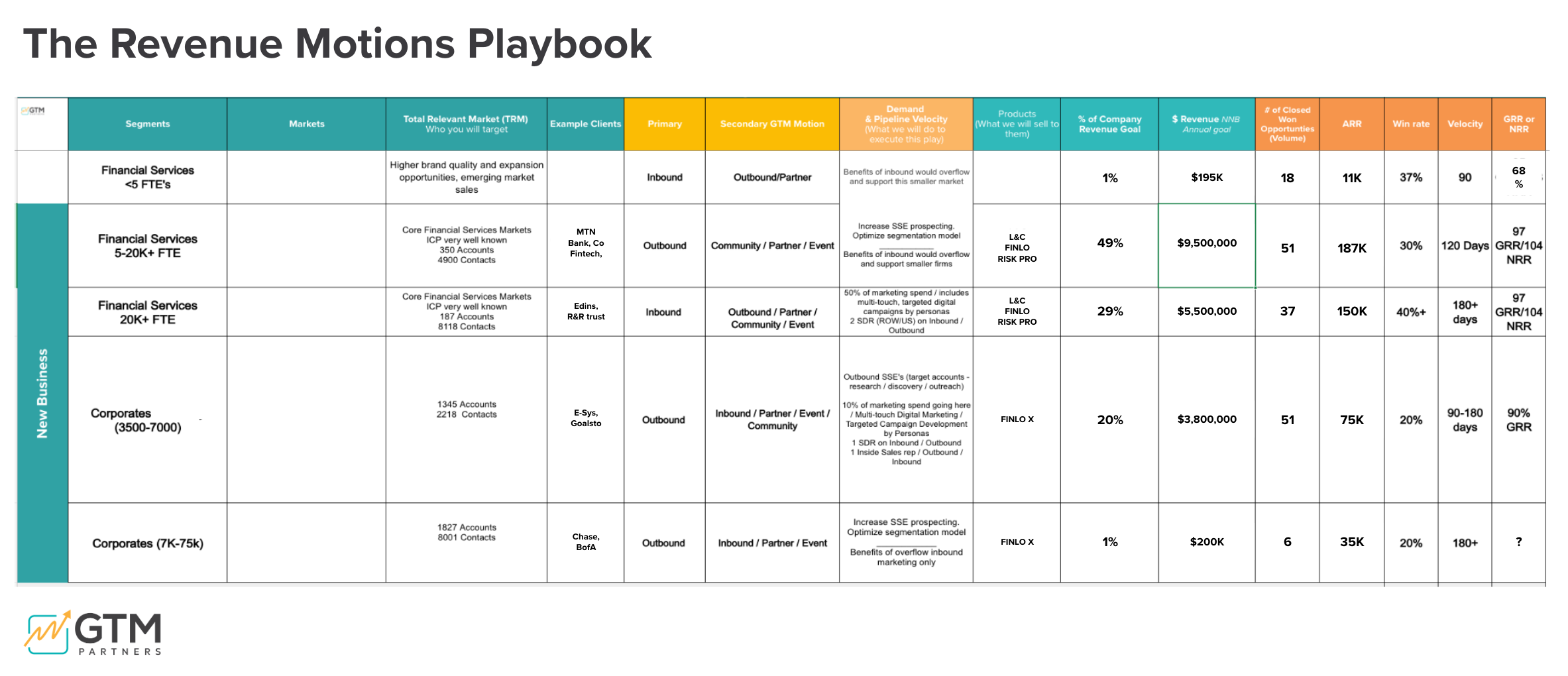
The Revenue Model Playbook Matrix by GTM Partners
Figure: The Revenue Model Playbook & Multi-Motion Orchestration Matrix

By GTM Partners

Frequently Asked Executive Questions

Click question to expand

To determine the right go-to-market motion for your business, start by evaluating your current market position, target audience, product maturity, and available resources. The GTM Partners framework outlines six core GTM motions: Inbound-Led, Outbound-Led, Product-Led, Partner-Led, Event-Led, and Community-Led. Each motion aligns with different business mechanics and market conditions.

For instance, if your product has a strong self-service component and you aim for rapid user adoption, a Product-Led motion might be optimal. Conversely, if your strategy involves leveraging existing relationships and ecosystems, a Partner-Led motion could accelerate growth. Consider your company's ability to execute these motions effectively, as resource constraints and execution capabilities are critical. Ultimately, the goal is to select the motion(s) that align with your strategic objectives and provide a predictable path to revenue, ensuring efficient pipeline creation, improved win rates, and sustainable growth.

GTM OS Canonical FrameworkThe 6 Core GTM Revenue Motions
Supporting Research & Deep DiveThe 6 Core Revenue Motions in B2B Go-to-Market

To determine which GTM motion to focus on—whether inbound, outbound, partners, product-led growth, events, or community—you must align your choice with your company's strategic objectives, market conditions, and resource capabilities. Each motion serves distinct purposes: inbound and outbound are demand generation engines; product-led growth leverages product usage for expansion; partner-led taps into ecosystem synergies; events create high-touch engagement; and community builds long-term brand affinity.

Evaluate your current GTM maturity using the MOVE Assessment and consider your Ideal Customer Profile (ICP), market positioning, and available resources. For instance, if your goal is rapid customer acquisition with limited sales resources, a product-led approach might be optimal. Conversely, if you're entering a new market or vertical, a partner-led motion could accelerate entry and credibility. Ultimately, the decision should enhance pipeline predictability, optimize win rates, and improve unit economics, ensuring sustainable growth and a Gross Revenue Retention (GRR) above 90%.

GTM OS Canonical FrameworkThe 6 Core GTM Revenue Motions
Supporting Research & Deep DiveThe 6 Core Revenue Motions in B2B Go-to-Market

The number of GTM motions you should run simultaneously depends on your company's resources and ability to execute effectively. According to GTM Partners' framework, each GTM motion—Inbound-Led, Outbound-Led, Product-Led, Partner-Led, Event-Led, and Community-Led—requires distinct skills, processes, and investments. The key is to align your GTM motions with your audience, product, geography, and market opportunities to find the optimal path to revenue.

For most companies, it's strategic to start with one or two well-aligned motions and expand as resources and market understanding grow. Running multiple motions can be beneficial, but only if you have the capacity to execute them well. Poor execution across too many motions can dilute focus and impact. Therefore, assess your current capabilities and market needs, and prioritize motions that align best with your strategic goals and resource availability.

GTM OS Canonical FrameworkThe 6 Core GTM Revenue Motions
Supporting Research & Deep DiveThe 6 Core Revenue Motions in B2B Go-to-Market

Your current demand-generation approach may not be producing enough pipeline because it likely lacks alignment with the appropriate GTM Motion tailored to your specific Segment, ICP, and Product. According to GTM Partners' frameworks, simply deploying a GTM Motion like Inbound or Outbound is insufficient unless it is integrated into a comprehensive Revenue Motion. This involves a complete growth system that includes clear ownership and coordination across Product, Marketing, Sales, and Customer Success functions. If your demand-generation strategy is not producing the desired pipeline, it may be due to a misalignment in these areas or an underinvestment in the necessary resources and skills required for execution. Re-evaluate your GTM Motion to ensure it is designed to meet the specific needs of your target market and is supported by the right organizational structure and resources.

GTM OS Canonical FrameworkThe 6 Core GTM Revenue Motions
Supporting Research & Deep DiveThe 6 Core Revenue Motions in B2B Go-to-Market

ACV, product complexity, and buyer behavior are critical factors influencing your GTM motion selection and effectiveness. High ACV products often necessitate a more personalized and consultative GTM motion, such as Outbound-Led or Partner-Led, to manage longer sales cycles and higher touchpoints. Conversely, lower ACV products may thrive in a Product-Led or Inbound-Led motion, where scalability and self-service are prioritized.

Product complexity dictates the need for educational and supportive GTM motions. Complex products may require Event-Led or Community-Led approaches to build trust and understanding, while simpler products can leverage Inbound or Product-Led motions for rapid adoption. Buyer behavior, including decision-making processes and channel preferences, further refines motion choice. Aligning your GTM motion with these factors ensures optimized pipeline velocity, improved win rates, and efficient resource allocation, ultimately driving predictable revenue growth.

GTM OS Canonical FrameworkThe 6 Core GTM Revenue Motions
Supporting Research & Deep DiveThe 6 Core Revenue Motions in B2B Go-to-Market

Adding a second revenue motion should be considered when your current motion has reached its scalability limits or when a new market opportunity demands a different approach. According to the GTM Partners' frameworks, the decision hinges on whether your existing motion can effectively address the new Segment + ICP + Product combination. If your current motion is underperforming in terms of pipeline velocity, win rates, or customer retention, it may indicate a need for a new motion tailored to the specific context of the new opportunity.

Before adding a second motion, assess if your organization can support it without diluting focus or resources from the existing successful motion. Use the Revenue Model Playbook to ensure the new motion is designed with clear ownership and alignment across all GTM functions. This strategic addition should enhance predictable pipeline generation and improve unit economics, ensuring that Gross Revenue Retention remains above 90%.

GTM OS Canonical FrameworkThe 6 Core GTM Revenue Motions
Supporting Research & Deep DiveThe 6 Core Revenue Motions in B2B Go-to-Market

Yes, you can effectively use both product-led and sales-led growth together, leveraging the strengths of each to optimize your go-to-market strategy. According to GTM Partners' framework, the key is to integrate these motions within a cohesive Revenue Motion that aligns with your segment, ICP, and product strategy. Product-led growth (PLG) can drive initial adoption and expansion through user engagement and discovery, often serving as a feeder for sales-led efforts where larger deals or complex sales cycles require a more personalized touch.

By combining these approaches, you can create a predictable pipeline and enhance win rates by capturing a broader spectrum of customer needs and behaviors. Ensure your organization has the resources and execution capabilities to manage both motions effectively, as this dual approach demands precise coordination across marketing, sales, and customer success teams. This strategic alignment can lead to improved sales cycles and higher gross revenue retention (GRR > 90%), ultimately optimizing your unit economics and driving sustainable growth.

GTM OS Canonical FrameworkThe 6 Core GTM Revenue Motions
Supporting Research & Deep DiveThe 6 Core Revenue Motions in B2B Go-to-Market
Explore All GTM Answers & Topics