GTM Partners
Get Started
HomeAnswersThe 15 GTM Problems
All GTM Answers
Diagnosis, Leadership & Operating Model

The 15 GTM Problems

The 15 GTM Problems give executive teams a common way to diagnose where growth is breaking across market focus, pipeline, customer value, expansion, operations, and leadership.

The 15 GTM Problems Framework Taxonomy by GTM Partners
Figure: The 15 GTM Problems CEOs Must Recognize Across the 8 Pillars

By GTM Partners

Frequently Asked Executive Questions

Click question to expand

To diagnose what's holding your growth back, leverage the GTM Partners' framework of the 15 GTM Problems. Begin by gathering your functional leaders to identify their top 3-5 challenges from this list, which serves as a diagnostic tool to pinpoint systemic go-to-market failure modes. This exercise will align your team around the most significant barriers to growth, whether they stem from misaligned KPIs across departments, lack of a centralized GTM process, or selling to the wrong customer segments.

Additionally, assess your current stage within the MOVE framework—Problem Market Fit, Product Market Fit, or Platform Market Fit. Aligning your GTM strategy with your current stage is crucial to prevent growth stalls from escalating into full breakdowns. This dual approach of identifying specific GTM problems and aligning your strategy with your business stage will provide clarity on the root causes of your growth challenges, enabling you to make informed strategic decisions to optimize pipeline predictability, improve win rates, and enhance customer retention.

GTM OS Canonical FrameworkThe 15 GTM Problems Framework

To diagnose why you're missing your number, start by leveraging the 15 GTM Problems framework to identify systemic issues in your go-to-market strategy. Gather your functional leaders and have them pinpoint their top 3-5 challenges from this list. This exercise will help align your team around the biggest barriers to growth, such as misaligned KPIs across departments, selling to the wrong customers, or disconnected handoffs in the customer journey.

Additionally, assess your GTM maturity using the MOVE framework to ensure your strategy aligns with your current stage of growth. Often, companies face GTM breakdowns due to stage mismatches, like applying later-stage tactics without achieving true product-market fit. By identifying these core issues, you can make informed decisions to optimize your pipeline, improve win rates, and enhance customer retention, ultimately driving predictable revenue growth.

GTM OS Canonical FrameworkThe 15 GTM Problems Framework

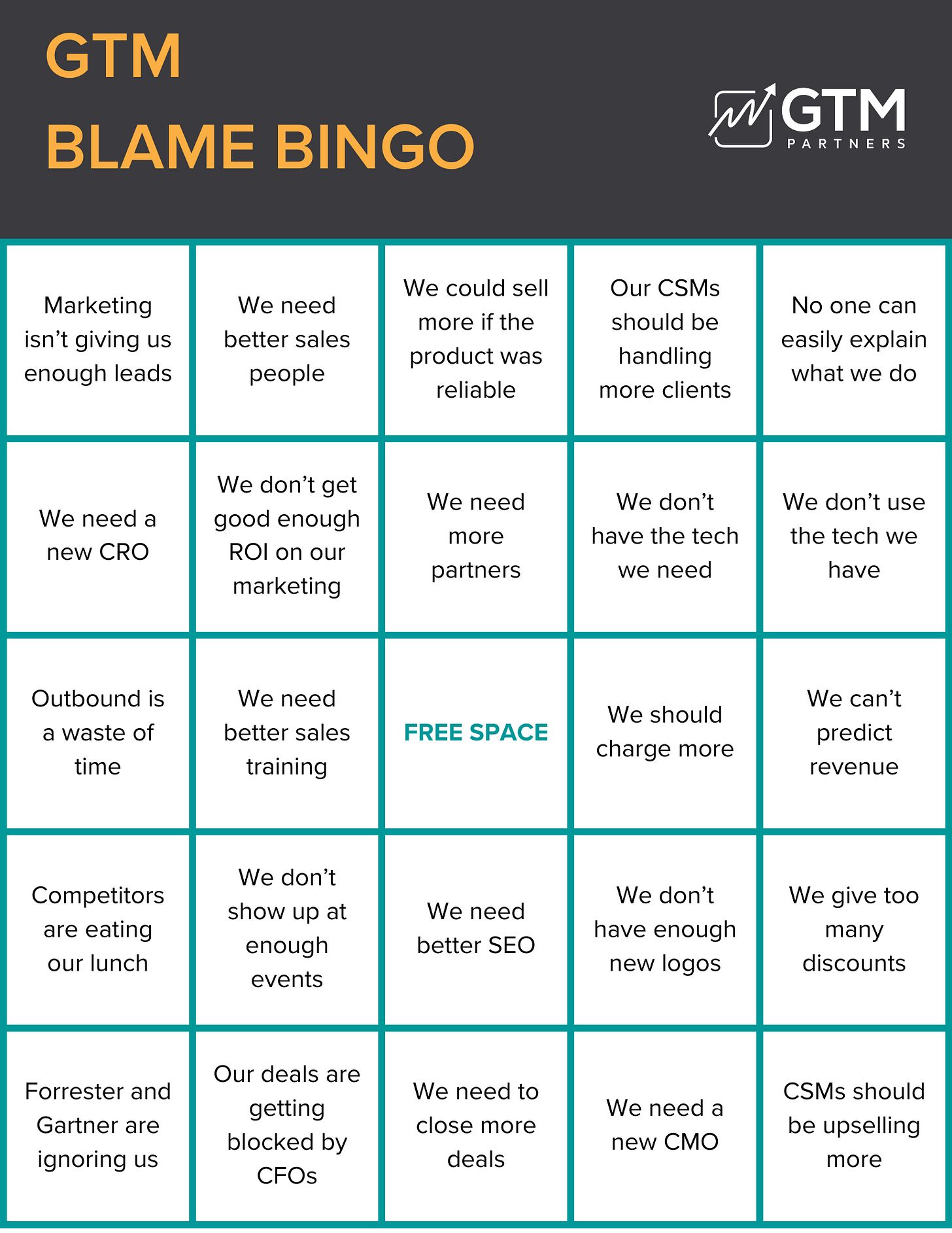
Sales, marketing, and customer success blaming one another is a classic symptom of a deeper go-to-market (GTM) problem, not isolated departmental issues. According to GTM Partners' frameworks, the root cause often lies in misalignment across these functions, which collectively form the revenue team. The CEO must own the GTM strategy, ensuring alignment in goals, metrics, and incentives across all functions. This includes transitioning from siloed operations to a unified approach where sales, marketing, and customer success share a common understanding of data and coordinated messaging throughout the buyer journey. RevOps plays a critical role here, acting as the unbiased truth-teller that aligns processes and data, ideally reporting directly to the CEO. By addressing these systemic alignment issues, you can improve predictable pipeline, win rates, and customer retention, ultimately enhancing your company's unit economics.

GTM OS Canonical FrameworkThe 15 GTM Problems Framework

The biggest GTM problems creating risk for a B2B company often revolve around misalignment and unpredictability. Key issues include reliance on heroic sales efforts rather than scalable plays, lack of synchronization between Sales, Marketing, and Customer Success, and the inability to predict and forecast revenue accurately. These problems lead to inconsistent pipeline velocity, unpredictable win rates, and extended sales cycles, ultimately affecting Gross Revenue Retention (GRR) and unit economics. Additionally, heavy discounting and feature wars can erode your value proposition, making it difficult to maintain competitive differentiation and customer loyalty. To mitigate these risks, focus on aligning your teams around a cohesive GTM strategy, leveraging the MOVE framework to diagnose and address these systemic issues, and ensuring your GTM Operating System is robust and integrated across all functions.

GTM OS Canonical FrameworkThe 15 GTM Problems Framework

To separate the root cause from the symptom in your GTM strategy, leverage the 15 GTM Problems framework as a diagnostic tool. This framework helps identify systemic failure modes across the customer lifecycle. Begin by examining the most common GTM failure modes: lack of a centralized GTM process, absence of a clear executive GTM owner, and misalignment in KPIs across marketing, sales, and customer success. These issues often manifest as symptoms like unpredictable pipeline, low win rates, and poor customer retention.

Focus on diagnosing whether your organization is solving for individual functions rather than end-to-end revenue, or if you're selling to the wrong customers and relying on customer success to salvage bad-fit accounts. By identifying these root causes, you can address the underlying problems rather than just treating symptoms, leading to improved pipeline predictability, higher win rates, and enhanced gross revenue retention (GRR > 90%). Use the GTM OS pillars to ensure alignment and execution across teams, reinforcing a cohesive GTM strategy.

GTM OS Canonical FrameworkThe 15 GTM Problems Framework

Your leaders may be busy, but flat growth often indicates a misalignment in your Go-to-Market (GTM) strategy, as outlined in GTM Partners' 15 GTM Problems framework. It's crucial to diagnose whether your team is working in sync towards a unified strategy or if they're fragmented, each pursuing different priorities. This misalignment can result in inefficiencies, reactive decision-making, and an inability to forecast revenue accurately, all of which stifle growth.

To address this, gather your leadership team and assess your GTM strategy using the GTM OS framework. Focus on aligning your team around a shared understanding of strategic priorities, ensuring that your Ideal Customer Profile (ICP) guides your initiatives, and that you have a unified GTM dashboard to track success metrics. This strategic clarity will enable you to prioritize effectively, improve pipeline predictability, and ultimately drive sustainable growth.

GTM OS Canonical FrameworkThe 15 GTM Problems Framework

To determine whether to prioritize fixing your pipeline, positioning, retention, or operations, start by diagnosing your company's specific GTM issues using the GTM Partners' 15 GTM Problems framework. This diagnostic-first approach will help identify the root cause of your challenges. Typically, pipeline issues are symptomatic of broader problems in positioning or market understanding, which are foundational elements in the GTM OS. Begin by assessing your Total Relevant Market (TRM) and Market Investment Map (MIM) to ensure you are targeting the right market segments and aligning your product offerings with customer value.

If your TRM and MIM are solid, but you're still facing challenges, evaluate your Brand & Demand and Pipeline Velocity to optimize engagement and accelerate revenue generation. Retention issues often indicate problems with Customer Time-to-Value and Customer Expansion strategies, impacting Gross Revenue Retention (GRR). Operations should be refined to support these strategic priorities, ensuring metrics and processes drive business health. Prioritize based on the sequence that addresses the most critical gaps impacting predictable pipeline, win rates, and customer retention.

GTM OS Canonical FrameworkThe 15 GTM Problems Framework
Explore All GTM Answers & Topics