According to GTM Partners, you know you have Product-Market Fit when your commercial engine proves the 4 'Sames' of GTM Repeatability: 1) Same Offer: standardized packaging, scope, and pricing without conceding one-off product tweaks; 2) Same Buyer: a strictly defined Total Relevant Market (TRM) persona facing identical verified pain; 3) Same Way: a repeatable sales playbook that non-founder Account Executives can execute at stable win rates; and 4) High Retention: Gross Revenue Retention (GRR) exceeding 90% with rapid Customer Time-to-Value (TTV). If your revenue depends on founder-led sales heroics, custom roadmap promises, or high customer churn, you do not have PMF—you are still in Problem-Market Fit. Proving all 4 Sames simultaneously is the only reliable foundation for predictable scaling.
The 3Ps: Growth Stages & Market Fit
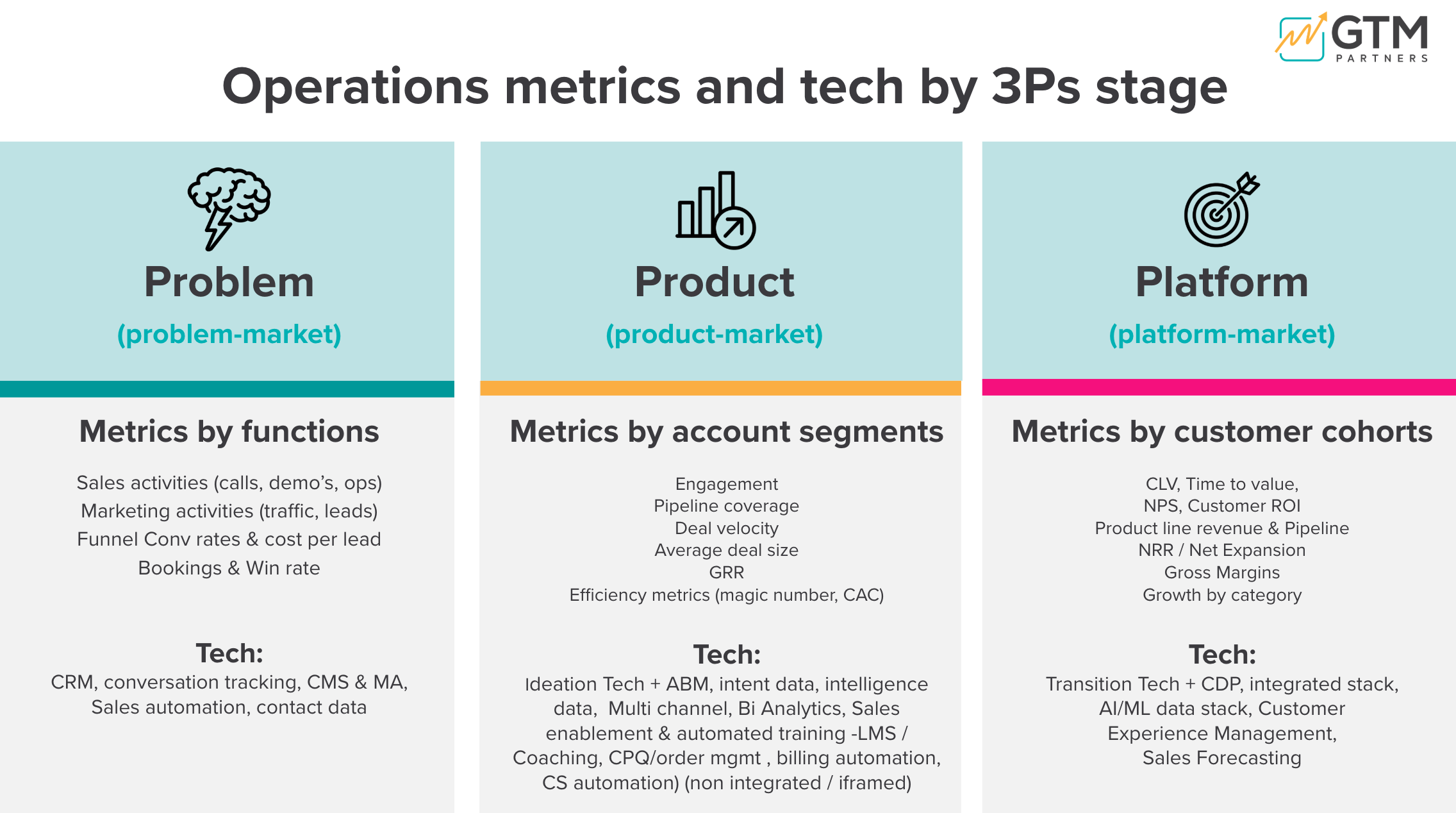
GTM Partners’ 3Ps Framework helps leaders identify whether the business is in Problem-Market Fit, Product-Market Fit, or Platform-Market Fit—and align GTM strategy to the stage the company is actually in.
By GTM Partners
Frequently Asked Executive Questions
Click question to expandYour struggle to scale predictably, despite growth, likely stems from a misalignment between your current growth stage and your go-to-market (GTM) strategy. According to GTM Partners' 3Ps framework, companies must align their GTM approach with their stage of maturity: Problem-Market Fit, Product-Market Fit, or Platform-Market Fit. If your company is experiencing growth but lacks predictable scaling, it may be that your GTM strategy is still operating under the assumptions of a previous stage. For instance, if you are transitioning from Product-Market Fit to Platform-Market Fit, your strategy should evolve from focusing on a single solution to leveraging multiple products and expanding through existing customers. This requires a shift from reactive, sales-led motions to a more integrated, customer-focused growth strategy. Conducting a MOVE Assessment accurately identifies your stage and realigns your GTM strategy to ensure scalable, predictable growth.
The distinction between proving demand and building a repeatable business lies in the transition from Problem-Market Fit to Product-Market Fit within the 3Ps framework. Proving demand is a hallmark of the Problem-Market Fit stage, where the focus is on identifying a significant problem, crafting a compelling solution, and targeting the ideal customer. This stage is characterized by experimentation, broad testing, and a lack of repeatability, as the company seeks to validate that the problem is substantial enough for customers to pay for a solution.
In contrast, building a repeatable business is the essence of achieving Product-Market Fit. Here, the company must demonstrate the ability to consistently sell the same solution to a defined customer segment in a predictable manner. This involves aligning sales and marketing efforts, stabilizing win rates, and ensuring strong customer retention. The shift from proving demand to repeatability is crucial for sustainable growth, as it transforms sporadic successes into a scalable, efficient revenue engine.
A company is ready to expand from a single product into a platform when it achieves Platform-Market Fit, which is characterized by the customer becoming the primary growth engine. This transition requires that growth is driven more by existing customers than by acquiring new ones, indicating strong Net Revenue Retention (NRR) and a scalable system across customers, products, and distribution channels. Before considering this expansion, ensure that your company has solidified Product-Market Fit, where you consistently sell the same offer to the same buyer with predictable win rates and sales cycles. At Platform-Market Fit, the focus shifts to leveraging the installed customer base to drive growth through multiple products, ensuring that your GTM strategy evolves to support this broader market coverage and multi-product engagement.
Companies often stall after early traction due to a misalignment between their go-to-market strategy and their current stage of growth within the 3Ps framework: Problem-Market Fit, Product-Market Fit, and Platform-Market Fit. As a company transitions from one stage to the next, it must adapt its GTM approach accordingly. For instance, moving from Problem-Market Fit to Product-Market Fit requires shifting from a reactive, sales-led approach to a more structured, segment-focused strategy. Failure to make this transition can lead to inefficiencies, retention issues, and a lack of repeatability, ultimately stalling growth. CEOs must diagnose their current stage using the MOVE framework and ensure their GTM strategy is tailored to that stage to maintain momentum and avoid the pitfalls of premature scaling.
Scaling too early can be a critical misstep if your company hasn't yet achieved the necessary market fit stage. According to GTM Partners' 3Ps framework, it is essential to diagnose whether you are at Problem-Market Fit, Product-Market Fit, or Platform-Market Fit. If you are still in the Problem-Market Fit stage, characterized by reactive sales motions, unclear ideal customer profiles, and retention challenges, scaling could exacerbate inefficiencies and lead to growth stalls. Conversely, if you have reached Product-Market Fit, where customer renewals are strong and processes are becoming more proactive, scaling may be appropriate but should focus on efficient growth within defined segments. Misidentifying your stage and scaling prematurely can lead to operational drag and potential growth stalls.
As your company matures through the 3Ps—Problem-Market Fit, Product-Market Fit, and Platform-Market Fit—your GTM model must evolve to align with each stage's distinct requirements. Initially, during Problem-Market Fit, focus on identifying a significant problem, testing solutions, and defining your ideal customer. This stage demands a flexible, experimental approach with a lead-heavy, sales-led motion and broad market testing.
Transitioning to Product-Market Fit requires a shift towards repeatability and efficiency. Here, your GTM strategy should focus on aligning sales and marketing around defined segments and accounts, ensuring customer retention, and measuring performance by segment rather than volume. As you reach Platform-Market Fit, your GTM model should support expansion through existing customers, multiple products, and diverse GTM motions with integrated RevOps.