GTM Partners
Get Started
HomeAnswersDefining Go-to-Market (What is GTM?)
All GTM Answers
GTM Operating System & Strategy

Defining Go-to-Market (What is GTM?)

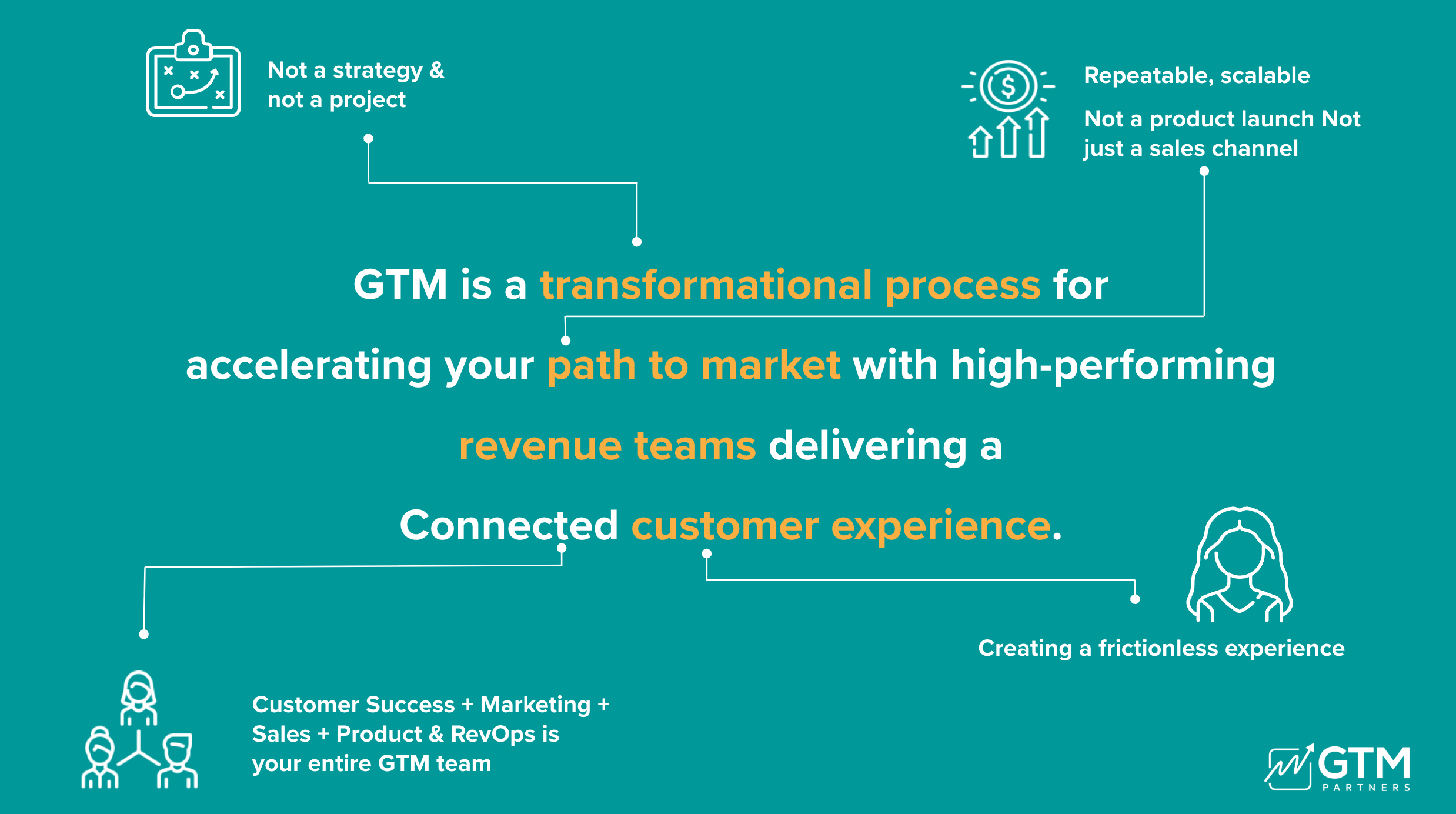
In their Wall Street Journal bestselling book *MOVE: The 4-Question Go-to-Market Framework*, GTM Partners co-founders Sangram Vajre and Bryan Brown define Go-to-Market as: **"GTM is a transformational process for accelerating your path to market with high-performing revenue teams delivering a connected customer experience."** GTM is not a single department, a marketing campaign, or a sales channel. It is the central operating discipline connecting business strategy to customer outcomes by aligning Product, Marketing, Sales, Customer Success, and RevOps across the customer lifecycle. The GTM Operating System™ (GTM OS) replaces functional silos with an 8-pillar operating discipline designed to drive efficient, durable growth.

The Definition of Go-to-Market by GTM Partners
Figure: Go-to-Market Definition & 4 Essential Truths (MOVE Book)

By GTM Partners

Frequently Asked Executive Questions

Click question to expand

In their bestselling book *MOVE: The 4-Question Go-to-Market Framework*, GTM Partners co-founders Sangram Vajre and Bryan Brown define Go-to-Market as: "GTM is a transformational process for accelerating your path to market with high-performing revenue teams delivering a connected customer experience." GTM is not a single department, a marketing campaign, or a sales channel. It includes everything required to acquire, retain, and expand customers: defining your Total Relevant Market (TRM), aligning brand positioning and Point of View (POV), orchestrating modern revenue motions, accelerating customer onboarding and time-to-value, and maintaining cross-functional execution rhythm across Product, Marketing, Sales, Customer Success, and RevOps.

No. Marketing and Sales are individual functional disciplines within GTM, whereas Go-to-Market is the total company operating system unifying Product, Marketing, Sales, Customer Success, and RevOps across the full customer lifecycle. Marketing creates category awareness and generates demand; Sales converts qualified pipeline into closed revenue. GTM encompasses the entire business model—including product-market fit, pricing and packaging, onboarding velocity, Gross Revenue Retention, and net expansion.

The CEO must own Go-to-Market because GTM requires cross-functional tradeoffs, resource allocation, and accountability that cross functional lines and exceed the authority of any single department head. When GTM is delegated solely to sales or marketing, teams default to functional silos—sales blames marketing for lead quality, marketing blames sales for execution, and product builds features detached from commercial demand. Only the CEO has the organizational authority to align Product, Sales, Marketing, and Customer Success around one unified operating plan.

Supporting Research & Deep DiveThe CEO Owns GTM. Let Me Prove It.
Official PDF Guide & PlaybookThe CEO Manifesto (PDF)

Revenue frequently flatlines when departments optimize for disconnected functional goals rather than an integrated go-to-market strategy. Marketing may hit lead volume targets with non-ICP contacts, sales chases one-off deals by discounting, product builds features that do not solve core market problems, and customer success inherits accounts destined to churn. Having one unified GTM strategy aligns all teams around an agreed Total Relevant Market (TRM), shared revenue motions, clear handoffs, and a common 90-day execution cadence.

A functional problem is localized—such as poor copy on a marketing landing page or an individual rep struggling with objection handling. A GTM problem is systemic and cross-functional: handoffs break down, pipeline velocity slows despite high activity, customer acquisition costs rise while retention falls, or departments blame one another for missed targets ('GTM Blame Bingo'). If fixing an individual department's metrics does not improve overall revenue predictability or customer retention, you are dealing with a company-wide GTM operating problem.

A high-performing GTM operating model replaces departmental silos with an integrated company operating discipline. Developed by GTM Partners, the GTM Operating System™ (GTM OS) organizes execution across 8 core pillars: 1) Total Relevant Market (TRM), 2) Market Investment Map (MIM), 3) Brand & Demand, 4) Pipeline Velocity, 5) Customer Time-to-Value (CTV), 6) Customer Expansion, 7) Revenue Operations (RevOps), and 8) Leadership & Management Rhythm. A good operating model aligns the executive team on a single 'GTM OS on a Slide' and executes in synchronized 90-day quarterly sprints.

Explore All GTM Answers & Topics